Advertisements
Advertisements
प्रश्न
An electric bulb is rated 250 W, 230 V.
- the energy consumed in one hour, and
- the time in which the bulb will consume 1.0 kWh energy when connected to 230 V mains.
Advertisements
उत्तर
(i) Given, Power (P) = 250 W, Voltage (V) = 230 V, Time (t) = 1 h = 3600 sec, Energy (E) = ?
Energy, E = P × t
Substituting the values in the formula above, we get,
E = 250 × 3600
E = 9 × 10⁵ J
(ii) Let t be the time in which the bulb will consume 1.0 kWh energy when connected to 230 V mains.
P = 1.0 kWh = 1000 Wh
Substituting the value in the formula, we get,
⇒ 1000 = 250 × t
⇒ t = `1000/250`
⇒ t = 4 h
Hence, time = 4 h
संबंधित प्रश्न
Which particles constitute the electric current in a metallic conductor?
<p> Define the unit of electric current (or Define ampere).
A battery of 9 V is connected in series with resistors of 0.2 Ω, 0.3 Ω, 0.4 Ω, 0.5 Ω and 12 Ω. How much current would flow through the 12 Ω resistor?
Draw a circuit diagram to show how two 4 V electric lamps can be lit brightly from two 2 V cells.
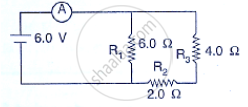
Three resistors of 6.0 𝛀, 2.0𝛀 and 4.0𝛀 are joined to an ammeter A and a cell of e.m.f. 6.0 V as
shown in fig 8.52 Calculate:
(a) the effective resistance of the circuit and
(b) the reading of ammeter.
Tick(✓) the correct choice in the following:
24 watt, 12 volt head lamp is fully lit by connecting it to a 12 volt
battery. The working resistance of the lamp is
Fig . shows the core of a transformer and i ts input and output connections
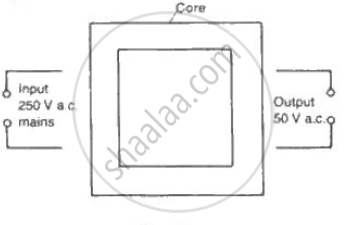
State the material used for the core and describe th e structure of the core.
(a) Use the values given in the diagram to calculate the turns ratio for the transformer and connections, labeling all parts of the diagram .
(b) If a current of 2 A is taken from th e output, calculate th e current in the input circuit (Assume the transformer to be ideal ).
A bulb marked 12 V, 24 W operates on a 12 V battery for 20 minutes. Calculate:
- The current flowing through it, and
- The energy consumed.
