Advertisements
Advertisements
प्रश्न
An electric bulb is rated 250 W, 230 V.
- the energy consumed in one hour, and
- the time in which the bulb will consume 1.0 kWh energy when connected to 230 V mains.
Advertisements
उत्तर
(i) Given, Power (P) = 250 W, Voltage (V) = 230 V, Time (t) = 1 h = 3600 sec, Energy (E) = ?
Energy, E = P × t
Substituting the values in the formula above, we get,
E = 250 × 3600
E = 9 × 10⁵ J
(ii) Let t be the time in which the bulb will consume 1.0 kWh energy when connected to 230 V mains.
P = 1.0 kWh = 1000 Wh
Substituting the value in the formula, we get,
⇒ 1000 = 250 × t
⇒ t = `1000/250`
⇒ t = 4 h
Hence, time = 4 h
संबंधित प्रश्न
What is the current in a circuit if the charge passing each point is 20 C in 40 s?
Which effect of current is utilised in an electric light bulb?
Calculate the amount of energy transferred by a 10 A electric current flowing through a resistor of 5 o for 15 minutes.
Two resistors of 4 Ω and 6 Ω are connected in parallel. The combination is
connected across a 6 volt battery of negligible resistance. Calculate:
( i) The power supplied by the battery,
(ii) The power dissipated in each resistor.
Tick(✓) the correct choice in the following:
24 watt, 12 volt head lamp is fully lit by connecting it to a 12 volt
battery. The working resistance of the lamp is
Fig. shows a 3 pin plug with the cover removed. The electric cable
connected to the plug contains 3 wires with colour coded insulation namely brown, blue and green.
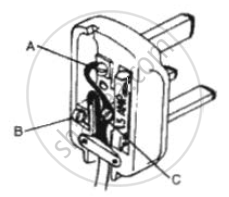
- Identify each of the colour coded wires by stating to which of the
terminals A, B or C in the diagram they should be connected. - Identify the terminal through which no current passes in normal
circumstances. - What is the purpose of the earthed wire connected to an electric
appliance like an electric heater? Describe how it works.
Calculate the current through a 60 W lamp rated 250 V. If the line voltage falls to 200 V, how is power consumed by the bulb affected?
What should I choose ___________________
b. for getting protection from electric current.
c. to measure the current in the circuit?
Assertion (A): Electric current will not flow between two charged bodies when connected if their charges are the same.
Reason (R): Current is the rate of flow of charge.
