Advertisements
Advertisements
प्रश्न
An electric circuit consisting of a 0.5 m long nichrome wire XY, an ammeter, a voltmeter, four cells of 1.5 V each and a plug key was set up.
Following graph was plotted between V and I values:
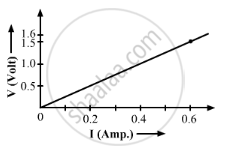
What would be the values of `V/I` rations when the potential difference is 0.8 V, 1.2 V and 1.6 V respectively?
What conclusion do you draw from these values?
What is the resistance of the wire?
Advertisements
उत्तर
When potential difference = 0.8 V, current = 0.32 A.
`V/I=0.8/0.32`
`V/I = 2.5`
When potential difference = 1.2 V, current = 4.8 A.
`V/I= 12/48`
`V/I=2.5`
When/ /potential difference = 1.6 V, current = 6.4 A.
`V/I= 1.6/6.4 `
`V/I =2.5`h V-I graph is a straight line with a constant slope of 2.5.
The resistance of the wire is 2.5 Ω.
APPEARS IN
संबंधित प्रश्न
A current of 4 A flows around a circuit for 10 s. How much charge flows past a point in the circuit in this time?
What is the current in a circuit if the charge passing each point is 20 C in 40 s?
<p> Define the unit of electric current (or Define ampere).
In 10 s, charge of 25 C leaves a battery, and 200 J of energy are delivered to an outside circuit a result.
What current flows from the battery?
Which statement/statement is/are correct?
1. An ammeter is connected in series in a circuit and a voltmeter is connected in parallel.
2. An ammeter has a high resistance.
3. A voltmeter has a low resistance.
(a) 1, 2, 3
(b) 1, 2
(c) 2, 3
(d) 1
State the factors on which the strength of electric current flowing in a given conductor depends.
A p.d. of 6 V is applied to two resistors of 3 Ω and 6 Ω connected in parallel. Calculate:
(a) the combined resistance
(b) the current flowing in the main circuit
(c) the current flowing in the 3 Ω resistor.
A switch must be connected in:
(a) Live wire (b) neutral wire
(c) earth wire (d) either earth or neutral wire
Draw a schematic diagram of an electric circuit consisting of a battery of two cells each of 1.5 V, 5 Ω, 10 Ω and 15 Ω resistors and a plug key, all connected in series.
The circuit diagram (Fig.) shows a battery of e.m.f. 6 volts and internal
resistance of 0.8 Ω oonnected in series. Find the
(a) Current reoorded by the ammeter,
(b) P.d. across the terminals of the resistor B,
( c) Current passing through each of the resistors B, C and D, and
( d) P.d. across the terminals of the battery.

In a house there are 6 bulbs of 100 W each used for 4 hours a day, 4 bulbs of 60 W each used for 8 hours a day, an immersion heater of 2.5 kW used for 1 hour per day, and an electric iron of 800 W used for 2 hours per day. Calculate the cost of monthly electric bill for the month of April at the rate of 80 p per unit.
An electric iron is rated 750 W, 230 V. Calculate the electrical energy consumed by the press in 16 hours.
A bulb marked 12 V, 24 W operates on a 12 V battery for 20 minutes. Calculate:
- The current flowing through it, and
- The energy consumed.
An electric bulb is rated 250 W, 230 V.
- the energy consumed in one hour, and
- the time in which the bulb will consume 1.0 kWh energy when connected to 230 V mains.
A bulb is connected to a battery of p.d. 4 V and internal resistance 2.5 Ω . A steady current of 0.5 A flows through the circuit. Calculate:
The resistance of the bulb
An electrical appliance is rated at 1000 KVA, 220V. If the appliance is operated for 2 hours, calculate the energy consumed by the appliance in: (i) kWh (ii) joule.
What does the direction of current convey?
