Advertisements
Advertisements
प्रश्न
An electric circuit consisting of a 0.5 m long nichrome wire XY, an ammeter, a voltmeter, four cells of 1.5 V each and a plug key was set up.
Following graph was plotted between V and I values:
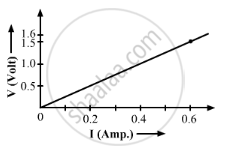
What would be the values of `V/I` rations when the potential difference is 0.8 V, 1.2 V and 1.6 V respectively?
What conclusion do you draw from these values?
What is the resistance of the wire?
Advertisements
उत्तर
When potential difference = 0.8 V, current = 0.32 A.
`V/I=0.8/0.32`
`V/I = 2.5`
When potential difference = 1.2 V, current = 4.8 A.
`V/I= 12/48`
`V/I=2.5`
When/ /potential difference = 1.6 V, current = 6.4 A.
`V/I= 1.6/6.4 `
`V/I =2.5`h V-I graph is a straight line with a constant slope of 2.5.
The resistance of the wire is 2.5 Ω.
APPEARS IN
संबंधित प्रश्न
Define the unit of current.
What is the Flow of Charge Called?
If the charge on an electron is 1.6 × 10⁻¹⁹ coulombs, how many electrons should pass through a conductor in 1 second to constitute 1 ampere current?
How many electrons are flowing per second past a point in a circuit in which there is a current of 5 amp?
(a) With the help of a circuit diagram, obtain the relation for the equivalent resistance of two resistances connected in parallel.
(b) In the circuit diagram shown below, find:
(i) Total resistance.
(ii) Current shown by the ammeter A

Draw a circuit diagram to show how two 4 V electric lamps can be lit brightly from two 2 V cells.
State two differences between the e.m.f and terminal voltage of a cell.
State the relation between work, charge and potential difference for an electric circuit.
Calculate the amount of energy transferred by a 10 A electric current flowing through a resistor of 5 o for 15 minutes.
Tick(✓) the correct choice in the following:
Which of the following quantities has the same value for all electrical
appliances connected to the ring main circuit in a house?
Fig . shows the core of a transformer and i ts input and output connections

State the material used for the core and describe th e structure of the core.
(a) Use the values given in the diagram to calculate the turns ratio for the transformer and connections, labeling all parts of the diagram .
(b) If a current of 2 A is taken from th e output, calculate th e current in the input circuit (Assume the transformer to be ideal ).
An electric kettle is rated 2.5 kW, 250 V. Find the cost of running the kettle for two hours at Rs. 5.40 per unit.
Three resistances, of which two are equal when connected in series have an effective resistance of 30 ohms. When the three resistances are connected in parallel, the effective resistances is 3 ohms. Find the values of the individual resistances.
An electric bulb is marked 100 W, 250 V. How much current will the bulb draw if connected to a 250 V supply?
In current electricity, a positive charge refers to ______.
Match the items in column-I to the items in column-II:
| Column - I | Column - II | ||
| (i) | electric current | (a) | volt |
| (ii) | potential difference | (b) | ohm meter |
| (iii) | specific resistance | (c) | watt |
| (iv) | electrical power | (d) | joule |
| (v) | electrical energy | (e) | ampere |
Problems for practice:
If 3A current flows through a circuit, then convert the current in terms of a milliampere.
What is the rate at which charges flow past a point on a circuit?
