Advertisements
Advertisements
प्रश्न
Ten bulbs are connected in a series circuit to a power supply line. Ten identical bulbs are connected in a parallel circuit to an identical power supply line.
(b) In which circuit, if one bulbs be brighter?
Advertisements
उत्तर
(b) Parallel circuit
संबंधित प्रश्न
Choose the correct alternative and rewrite the following sentence.
When the resistance of a conductor increases, the current will ________ increase.
Compare how an ammeter and a voltmeter are connected in a circuit.
An electric circuit consisting of a 0.5 m long nichrome wire XY, an ammeter, a voltmeter, four cells of 1.5 V each and a plug key was set up.
(i) Draw a diagram of this electric circuit to study the relation between the potential difference maintained between the points 'X' and 'Y' and the electric current flowing through XY.
Two lamps, one rated 40 W at 220 V and the other 60 W at 220 V, are connected in parallel to the electric supply at 220 V.
(a) Draw a circuit diagram to show the connections.
(b) Calculate the current drawn from the electric supply.
(c) Calculate the total energy consumed by the two lamps together when they operate for one hour.
An electric bulb is rated as 10 W, 220 V. How many of these bulbs can be connected in parallel across the two wires of 220 V supply line if the maximum current which can be drawn is 5 A?
State the S.I. unit of current.
A fuse is a short piece of wire of high ______ and low ______.
Find the effective resistance in the following circuit diagrams (Fig.):
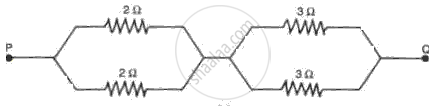
A battery of e.m.f. 15 V and internal resistance 2 Ω is connected to two resistors of resistances 4 ohm and 6 ohm joined (a) in series. Find in each case the electrical energy spent per minute in 6 Ω resistor.
In current electricity, a positive charge refers to ______.
For current to flow, one needs art open circuit.
A charge of 400C flows through a conductor for 13 minutes and 20 seconds. Find the magnitude of the current flowing through the conductor.
Electrons in a conductor move from:
Conventional current is defined as the direction in which which type of charge would flow?
What happens when the switch in a circuit is turned OFF (open circuit)?
