Advertisements
Advertisements
प्रश्न
An electric circuit consisting of a 0.5 m long nichrome wire XY, an ammeter, a voltmeter, four cells of 1.5 V each and a plug key was set up.
(i) Draw a diagram of this electric circuit to study the relation between the potential difference maintained between the points 'X' and 'Y' and the electric current flowing through XY.
Advertisements
उत्तर
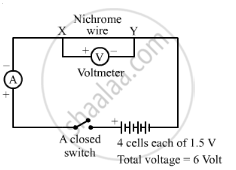
APPEARS IN
संबंधित प्रश्न
The atoms of copper contain electrons and the atoms of rubber also contain electrons. Then why does copper conduct electricity but rubber does not conduct electricity?
By what name is the physical quantity coulomb/second called?
What actually travels through the wires when you switch on a light?
If 20 C of charge pass a point in a circuit in 1 s, what current is flowing?
Which instrument is used to measure electric current? How should it be connected in a circuit?
In the circuit shown below, the voltmeter reads 10 V.
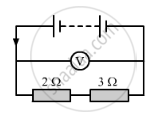
(a) What is the combined resistance?
(b) What current flows?
(c) What is the p.d. across 2 Ω resistor?
(d) What is the p.d. across 3 Ω resistor?
A wire of uniform thickness with a resistance of 27Ω is cut into three equal pieces and they are joined in parallel. Find the equivalent resistance of the parallel combination.
Draw a schematic diagram of an electric circuit consisting of a battery of two cells each of 1.5 V, 5 Ω, 10 Ω and 15 Ω resistors and a plug key, all connected in series.
Distinguish between an open and a closed circuit.
A fuse is a short piece of wire of high ______ and low ______.
Define the term kilowatt - hour and state its value in S.I. unit.
An electric bulb is rated 250 W, 230 V.
- the energy consumed in one hour, and
- the time in which the bulb will consume 1.0 kWh energy when connected to 230 V mains.
A bulb is connected to a battery of p.d. 4 V and internal resistance 2.5 Ω . A steady current of 0.5 A flows through the circuit. Calculate:
The resistance of the bulb
Two electric bulbs rated 100 W; 220 V and 60 W; 220 V are connected in parallel to electric mains of 220 V. Find the current drawn by the bulbs from the mains.
An electric bulb is marked 100 W, 250 V. How much current will the bulb draw if connected to a 250 V supply?
The SI unit for electric current is the coulomb.
A current of 1 A is drawn by a filament of an electric bulb. Number of electrons passing through a cross section of the filament in 16 seconds would be roughly
Match the items in column-I to the items in column-II:
| Column - I | Column - II |
| (i) electric current | (a) volt |
| (ii) potential difference | (b) ohm meter |
| (iii) specific resistance | (c) watt |
| (iv) Electrical power | (d) joule |
| (v) electrical energy | (e) ampere |
Conventional current is defined as the direction in which which type of charge would flow?
A charge of 20 C flows through a conductor in 4 s. The electric current through the conductor is:
