Advertisements
Advertisements
Question
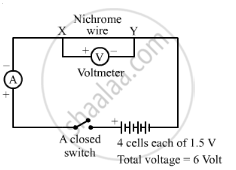
An electric circuit consisting of a 0.5 m long nichrome wire XY, an ammeter, a voltmeter, four cells of 1.5 V each and a plug key was set up.
(i) Draw a diagram of this electric circuit to study the relation between the potential difference maintained between the points 'X' and 'Y' and the electric current flowing through XY.
Advertisements
Solution
APPEARS IN
RELATED QUESTIONS
Fill in the folloing blank with suitable words:
A current is a flow of ............... .For this to happen there must be a ............... circuit.
A flash of lighting carries 10 C of charge which flows for 0.01 s. What is the current? If the voltage is 10 MV, what is the energy?
Match the pairs.
| ‘A’ Group | ‘B’ Group |
| 1. Free electrons | a. V/R |
| 2. Current | b. Increases the resistance in the circuit |
| 3. Resistivity | c. Weakly attached |
| 4. Resistances in series | d. VA/LI |
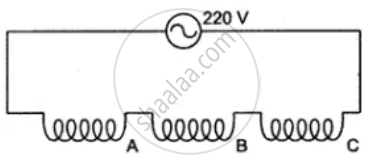
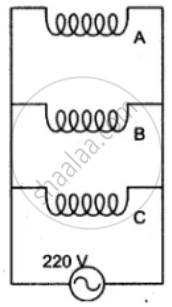
The diagram shows two ways of connecting three lamps P, Q and R to A.C. supply of 220 V.
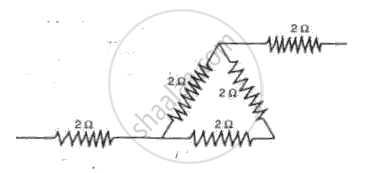
Find the effective resistance in the following circuit diagrams (Fig.):
Electrical appliances have voltage and power ratings as listed below. Which
has the larger working resistance?
| Appliances | Voltage (V) | Power (W) |
| (a) Washing machine | 250 | 3000 |
| ( b) Television | 240 | 160 |
| (c)240 | 240 | 1500 |
| ( d) Hair curler | 250 | 20 |
| ( e) Car head lamp | 12 | 36 |
1 kWh = `(1 "volt" xx 1 "ampere" xx "_________")/1000`
An electric bulb is rated '100 W, 250 V'. How much current will the bulb draw if connected to a 250 V supply?
State whether the following statement is True or False:
The SI unit of charge is the coulomb.
State the condition when it is advantageous to connect cells in series.
Which part of an electrical appliance is earthed?
Conventionally, the direction of the current is taken as:
When an electric current is passed, electrons move from:
1020 electrons, each having a charge of 1.6 x 10⁻¹⁹ C, flows in a circuit V is 0.1s. What is the current in ampere?
