Advertisements
Advertisements
Question
An electric circuit consisting of a 0.5 m long nichrome wire XY, an ammeter, a voltmeter, four cells of 1.5 V each and a plug key was set up.
Following graph was plotted between V and I values:
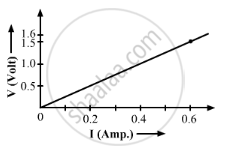
What would be the values of `V/I` rations when the potential difference is 0.8 V, 1.2 V and 1.6 V respectively?
What conclusion do you draw from these values?
What is the resistance of the wire?
Advertisements
Solution
When potential difference = 0.8 V, current = 0.32 A.
`V/I=0.8/0.32`
`V/I = 2.5`
When potential difference = 1.2 V, current = 4.8 A.
`V/I= 12/48`
`V/I=2.5`
When/ /potential difference = 1.6 V, current = 6.4 A.
`V/I= 1.6/6.4 `
`V/I =2.5`h V-I graph is a straight line with a constant slope of 2.5.
The resistance of the wire is 2.5 Ω.
APPEARS IN
RELATED QUESTIONS
The work done in moving a unit charge across two points in an electric circuit is a measure of ______.
A Radio Set Draws a Current of 0.36 a for 15 Minutes. Calculate the Amount of Electric Charge that Flows Through the Circuit.
A p.d. of 6 V is applied to two resistors of 3 Ω and 6 Ω connected in parallel. Calculate:
(a) the combined resistance
(b) the current flowing in the main circuit
(c) the current flowing in the 3 Ω resistor.
In the circuit shown below, the voltmeter reads 10 V.
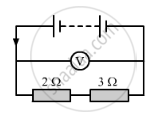
(a) What is the combined resistance?
(b) What current flows?
(c) What is the p.d. across 2 Ω resistor?
(d) What is the p.d. across 3 Ω resistor?
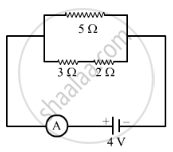
(a) With the help of a circuit diagram, obtain the relation for the equivalent resistance of two resistances connected in parallel.
(b) In the circuit diagram shown below, find:
(i) Total resistance.
(ii) Current shown by the ammeter A
If the lamps are both the same in the figure given below and if A1 reads 0.50 A, what do A2, A3, A4 and A5 read?
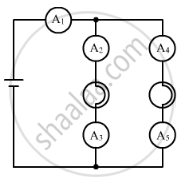
What happens to the other bulbs in a series circuit if one bulb blows off?
State the relation between work, charge and potential difference for an electric circuit.
Two resistors of 4 Ω and 6 Ω are connected in parallel. The combination is
connected across a 6 volt battery of negligible resistance. Calculate:
( i) The power supplied by the battery,
(ii) The power dissipated in each resistor.
In a house there are 6 bulbs of 100 W each used for 4 hours a day, 4 bulbs of 60 W each used for 8 hours a day, an immersion heater of 2.5 kW used for 1 hour per day, and an electric iron of 800 W used for 2 hours per day. Calculate the cost of monthly electric bill for the month of April at the rate of 80 p per unit.
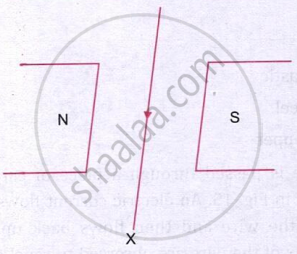
In fig. XY is at right angles to the magnetic field. The direction in which XY should be moved to induce an electron flow in the direction Y to X as indicated by the arrow is:
A bulb of 40 W is used for 12.5 h each day for 30 days. Calculate the electrical energy consumed.
Explain, why the potential difference across the terminals of a cell is more when the cell is not in use than it is when the cell is being used.
An electric bulb is marked 100 W, 250 V. How much current will the bulb draw if connected to a 250 V supply?
______ is used to measure the electric current.
Define an electric current.
Unit of electric power may also be expressed as
Calculate the current in a wire if a charge of 1500 coulomb flows through it in 5 minutes.
Common sources of Direct Current (DC) are:
The RMS value of AC is defined as:
