Advertisements
Advertisements
प्रश्न
An electric bulb of resistance 20 Ω and a resistance wire of 4 Ω are connected in series with a 6 V battery.
Draw the circuit diagram, and calculate:
(a) total resistance of the circuit.
(b) current through the circuit.
(c) potential difference across the electric bulb.
(d) potential difference across the resistance wire.
Advertisements
उत्तर
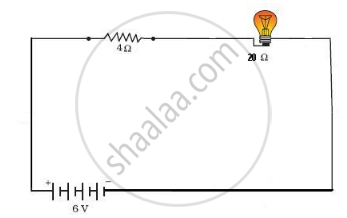
(a) Total resistance, R = 20 Ω + 4 Ω = 24 Ω
(b) Current through the circuit,
I = V/R
I = 6/24
I = 0.25 A
(c) Potential difference across the electric bulb,
Vbulb = IRbulb
`=0.25xx20`
= 5 V
(d) Potential difference across the resistance wire,
Vwire = IRwire
`= 0.25xx4`
= 1 V
APPEARS IN
संबंधित प्रश्न
The atoms of copper contain electrons and the atoms of rubber also contain electrons. Then why does copper conduct electricity but rubber does not conduct electricity?
What actually travels through the wires when you switch on a light?
In which direction does conventional current flow around a circuit?
What is an electric current?
Which statement/statement is/are correct?
1. An ammeter is connected in series in a circuit and a voltmeter is connected in parallel.
2. An ammeter has a high resistance.
3. A voltmeter has a low resistance.
(a) 1, 2, 3
(b) 1, 2
(c) 2, 3
(d) 1
If the current passing through a conductor is doubled, what will be the change in heat produced
The diagram shows two ways of connecting three lamps P, Q and R to A.C. supply of 220 V.
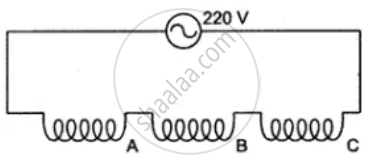
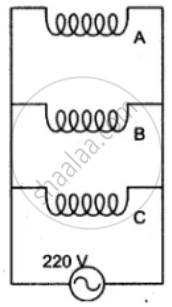
Tick(✓) the correct choice in the following:
A three pin plug is connected to the lead for a 1 kW electric iron to be
used on a 250 V supply. Which of the following statements is not correct?
Define the following:
Semiconductors
Find the effective resistance in the following circuit diagrams (Fig.):
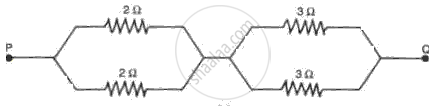
Find the effective resistance in the following circuit diagrams (Fig.):
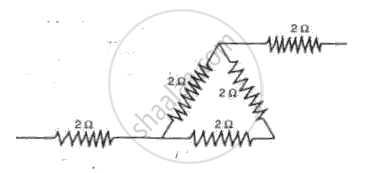
If a fuse contains a 5 A fuse wire and the voltage is 240 V, what is the maximum power (wattage) which may be taken from the circuit?
An electric bulb is rated at 220 V, 100 W.
- What is its resistance?
- What safe current can be passed through it?
Three heaters each rated 250 W, 100 V are connected in parallel to a 100 V supply. Calculate :
The total current taken from the supply
State the condition when it is advantageous to connect cells in series.
The flow of electric charge per unit time is called potential difference.
Conventional current is defined as the direction in which which type of charge would flow?
