Advertisements
Advertisements
प्रश्न
Why are metals good conductors of electricity whereas glass is a bad conductor of electricity? Give reason?
Advertisements
उत्तर
For a material to be a conductor, it has to have a reasonable number of free electrons (i.e. electrons that are loosely bound to there atoms).The more the number of free electrons available, the better it is as a conductor.Glass, for all practical purposes, has no free electrons in its crystalline structure, therefore, is an insulator. Whereas, metals have large number of free electrons in room temperature. Thus, metals are good conductors of electricity.
APPEARS IN
संबंधित प्रश्न
Three 2 V cells are connected in series and used as a battery in a circuit.
How many joules of electrical energy does 1 C gain on passing through (i) one cell (ii) all three cells?
What would be the danger involved in replacing a blown fuse with the one which would carry a large current?
Fig . shows the core of a transformer and i ts input and output connections
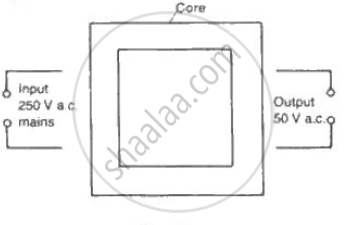
State the material used for the core and describe th e structure of the core.
(a) Use the values given in the diagram to calculate the turns ratio for the transformer and connections, labeling all parts of the diagram .
(b) If a current of 2 A is taken from th e output, calculate th e current in the input circuit (Assume the transformer to be ideal ).
Complete the following:
1 kWh = _________ J
Calculate the current through a 60 W lamp rated 250 V. If the line voltage falls to 200 V, how is power consumed by the bulb affected?
A bulb is connected to a battery of p.d. 4 V and internal resistance 2.5 Ω . A steady current of 0.5 A flows through the circuit. Calculate:
The resistance of the bulb
State the condition when it is advantageous to connect cells in parallel.
State the conditions for the flow of charge in a circuit from one point to the other.
