Advertisements
Advertisements
Question
An electric bulb of resistance 20 Ω and a resistance wire of 4 Ω are connected in series with a 6 V battery.
Draw the circuit diagram, and calculate:
(a) total resistance of the circuit.
(b) current through the circuit.
(c) potential difference across the electric bulb.
(d) potential difference across the resistance wire.
Advertisements
Solution
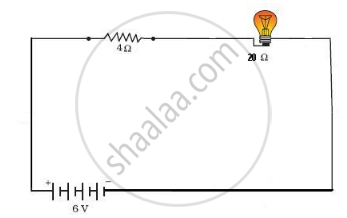
(a) Total resistance, R = 20 Ω + 4 Ω = 24 Ω
(b) Current through the circuit,
I = V/R
I = 6/24
I = 0.25 A
(c) Potential difference across the electric bulb,
Vbulb = IRbulb
`=0.25xx20`
= 5 V
(d) Potential difference across the resistance wire,
Vwire = IRwire
`= 0.25xx4`
= 1 V
APPEARS IN
RELATED QUESTIONS
Calculate the number of electrons constituting one coulomb of charge.
Three 2 V cells are connected in series and used as a battery in a circuit.
How many joules of electrical energy does 1 C gain on passing through (i) one cell (ii) all three cells?
If 20 C of charge pass a point in a circuit in 1 s, what current is flowing?
In which of the following cases more electrical energy is consumed per hour?
(i) A current of 1 ampere passed through a resistance of 300 ohms.
(ii) A current of 2 amperes passed through a resistance of 100 ohms.
Name two devices which work on the heating effect of electric current.
Two resistors of 2.0 Ω and 3.0 Ω are connected (a) in series (b) in parallel, with a battery of 6.0 V and negligible internal resistance. For each case draw a circuit diagram and calculate the current through the battery.
A battery of e.m.f. 15 V and internal resistance 3 ohm is connected to two resistors of resistance 3 ohm and 6 ohm in series. Find:
(i) The current through the battery,
(ii) The p.d. between the terminals of the battery.
Complete the following table. The first answer has been given as an example
| Quantity | Unit |
|
(a) Electrical potential Volt ( b) Resistance ( c) Power ( d) Energy ( e) Resistivity |
Volt ........ .......... ............ .............. |
If a fuse contains a 5 A fuse wire and the voltage is 240 V, what is the maximum power (wattage) which may be taken from the circuit?
What would be the danger involved in replacing a blown fuse with the one which would carry a large current?
An electric oven is rated as 1.5 kW, 250 V. If it is connected to a 250 V mains, calculate the
(a) Current drawn,
(b) Energy consumed in 20 hours,
(c) Cost of energy consumed in 20 hours at the rate of Re. 1 per unit.
An electric bulb is rated at 220 V, 100 W.
- What is its resistance?
- What safe current can be passed through it?
Coulomb is the SI unit of ____________.
What is the rate at which charges flow past a point on a circuit?
The relationship between conventional current and electron flow is that they are:
