Advertisements
Advertisements
Question
An electric bulb is rated at 220 V, 100 W.
- What is its resistance?
- What safe current can be passed through it?
Advertisements
Solution
- Given,
Power P = 100 W
Voltage V = 220 V
As power, P = `"V"^2/"R"`
R = `(220)^2/100`
= 484 Ω - The safe limit of current that can pass through it
I = `"P"/"V"`
I = `100/220`
= 0.45 A
APPEARS IN
RELATED QUESTIONS
If the charge on an electron is 1.6 × 10⁻¹⁹ coulombs, how many electrons should pass through a conductor in 1 second to constitute 1 ampere current?
In the circuit diagram given below, three resistors R1, R2, and R3 of 5 Ω, 10 Ω and 30 Ω, respectively are connected as shown
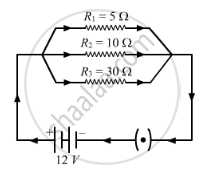
Calculate:
- current through each resistor.
- total current in the circuit.
- total resistance in the circuit.
For a heater rated at 4 kW and 220 V, calculate:
(a) the current,
(b) the resistance of the heater,
(c) the energy consumed in 2 hours, and
(d) the cost if 1 kWh is priced at Rs 4.60.
Find the effective resistance in the following circuit diagrams (Fig.):
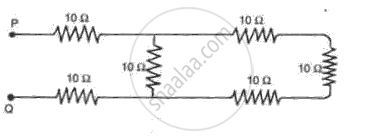
An electric oven is rated as 1.5 kW, 250 V. If it is connected to a 250 V mains, calculate the
(a) Current drawn,
(b) Energy consumed in 20 hours,
(c) Cost of energy consumed in 20 hours at the rate of Re. 1 per unit.
The power of an electric device is a product of ______ and ______.
