Advertisements
Advertisements
Question
State the relation between work, charge and potential difference for an electric circuit.
Advertisements
Solution
The relation between work (W), charge (Q) and potential difference (V):
The work required to be done (W) to move a positive charge Q, between two points in a circuit having potential difference V, is QV. That is,
W = QV
APPEARS IN
RELATED QUESTIONS
If the charge on an electron is 1.6 × 10⁻¹⁹ coulombs, how many electrons should pass through a conductor in 1 second to constitute 1 ampere current?
If the current through a floodlamp is 5 A, what charge passed in 10 seconds?
(a) 0.5 C
(b) 2 C
(c) 5 C
(d) 50 C
Three resistors are connected as shown in the diagram.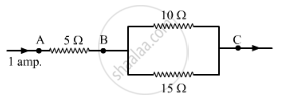
Through the resistor 5 ohm, a current of 1 ampere is flowing.
(i) What is the current through the other two resistors?
(ii) What is the p.d. across AB and across AC?
(iii) What is the total resistance
Consider the circuit given below:
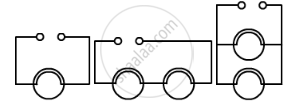
(a) In which circuit are the lamps dimmest?
(b) In which circuit or circuits are the lamps of equal brightness to the lamps in circuit (i)?
(c) Which circuit gives out the maximum light?
Tick(✓) the correct choice in the following:
24 watt, 12 volt head lamp is fully lit by connecting it to a 12 volt
battery. The working resistance of the lamp is
Calculate the current through a 60 W lamp rated 250 V. If the line voltage falls to 200 V, how is power consumed by the bulb affected?
State the conditions for the flow of charge in a circuit from one point to the other.
In metallic conductors, the charge carriers responsible for producing electric current are:
