Advertisements
Advertisements
Question
1 kWh = `(1 "volt" xx 1 "ampere" xx "_________")/1000`
Advertisements
Solution
1 kWh = `(1 "volt" xx 1 "ampere" xx bbunderline(1 "hour"))/1000`
APPEARS IN
RELATED QUESTIONS
Consider the circuit given below when A, B and C are three identical light bulbs of constant resistance. 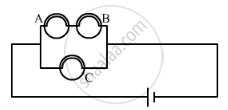
(a) List the bulbs in order of increasing brightness.
(b) If C burns out, what will be the brightness of A now compared with before?
(c) If B burns out instead, what will be the brightness of A and C compared with before?
How does the heat H produced by a current passing through a fixed resistance wire depend on magnitude of current I?
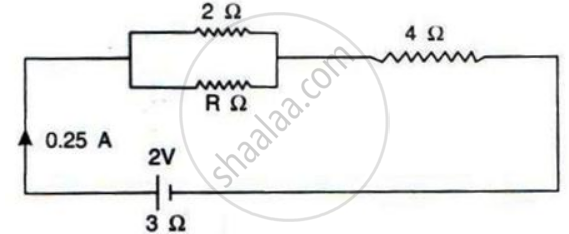
The following circuit diagram shows three resistors 2 Ω, 4 Ω and R Ω connected to a battery of e.m.f 2V and internal resistance 3 Ω. If the main current of 0.25 A flows through the circuit, find:
- the p.d. across the 4 Ω resistors,
- the p.d. across the internal resistance of the cell,
- the p.d. across the R Ω or 2 Ω resistors, and
- the value of R.
Define the following:
Electromotive force
Electrical appliances have voltage and power ratings as listed below. Which
has the larger working resistance?
| Appliances | Voltage (V) | Power (W) |
| (a) Washing machine | 250 | 3000 |
| ( b) Television | 240 | 160 |
| (c)240 | 240 | 1500 |
| ( d) Hair curler | 250 | 20 |
| ( e) Car head lamp | 12 | 36 |
The SI unit for electric current is the coulomb.
A current of 1 A is drawn by a filament of an electric bulb. Number of electrons passing through a cross section of the filament in 16 seconds would be roughly
Common sources of Alternating Current (AC) are:
