Advertisements
Advertisements
Question
The figure given below shows an electric circuit in which current flows from a 6 V battery through two resistors.
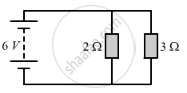
- Are the resistors connected in series with each other or in parallel?
- For each resistors, state the p.d. across it.
- The current flowing from the battery is shared between the two resistors. Which resistor will have bigger share of the current?
- Calculate the effective resistance of the two resistors.
- Calculate the current that flows from the battery.
Advertisements
Solution
- The resistors are connected in parallel.
- In a parallel arrangement, the voltage remains the same across each resistor. The battery is also connected in parallel with the resistors. Therefore, the p.d across each resistor is 6 V.
- The 2 Ω resistor will have the bigger share of the current since resistance is inversely proportional to the current.
- The effective resistance of the parallel combination is: `1R=1R_1+1R_2 1R=12+13 1R= 3 + 261 R = 56R = 65Ω R = 1.2 Ω `
`1/R=1/R_1+1/R_2`
`1/R=1/2+1/3`
`1/R=3+2/6`
`1/R=5/6`
`R=6/5` Ω
`R=1.2` Ω - The current flowing through the battery, I = 5 A
APPEARS IN
RELATED QUESTIONS
Three 2 V cells are connected in series and used as a battery in a circuit.
How many joules of electrical energy does 1 C gain on passing through (i) one cell (ii) all three cells?
Write down the formula which relates electric charge, time and electric current
In 10 s, charge of 25 C leaves a battery, and 200 J of energy are delivered to an outside circuit a result.
What current flows from the battery?
How do you think the brightness of two lamps arranged in parallel compares with the brightness of two lamps arranged in series (both arrangements having one cell)?
Tell the odd one out. Give a proper explanation.
The following table shows the current in Amperes and potential differences in Volts.
- Find the average resistance.
- What will be the nature of the graph between the current and potential difference? (Do not draw a graph.)
- Which law will the graph prove? Explain the law.
| V (volts) | I (amp) |
| 4 | 9 |
| 5 | 11.25 |
| 6 | 13.5 |
Complete the following table. The first answer has been given as an example.
| Quantity | Unit | |
| (a) | Electrical potential | volt |
| (b) | Resistance | ........ |
| (c) | Power | ........ |
| (d) | Energy | ........ |
| (e) | Resistivity | ........ |
If a fuse contains a 5 A fuse wire and the voltage is 240 V, what is the maximum power (wattage) which may be taken from the circuit?
Name the principle on which a transformer works.
A bulb is connected to a battery of p.d. 4 V and internal resistance 2.5 Ω . A steady current of 0.5 A flows through the circuit. Calculate:
The resistance of the bulb
Kilowatt hour is the unit of
Coulomb is the SI unit of ____________.
A current of 2A passing through the conductor produces 80 J of heat in 10 seconds. The resistance of the conductor is ______.
Which of the following correctly represents the formula for electric current?
In electrolytes, the ions carrying charge move toward:
