Advertisements
Advertisements
प्रश्न
The figure given below shows an electric circuit in which current flows from a 6 V battery through two resistors.
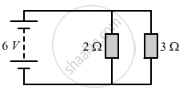
- Are the resistors connected in series with each other or in parallel?
- For each resistors, state the p.d. across it.
- The current flowing from the battery is shared between the two resistors. Which resistor will have bigger share of the current?
- Calculate the effective resistance of the two resistors.
- Calculate the current that flows from the battery.
Advertisements
उत्तर
- The resistors are connected in parallel.
- In a parallel arrangement, the voltage remains the same across each resistor. The battery is also connected in parallel with the resistors. Therefore, the p.d across each resistor is 6 V.
- The 2 Ω resistor will have the bigger share of the current since resistance is inversely proportional to the current.
- The effective resistance of the parallel combination is: `1R=1R_1+1R_2 1R=12+13 1R= 3 + 261 R = 56R = 65Ω R = 1.2 Ω `
`1/R=1/R_1+1/R_2`
`1/R=1/2+1/3`
`1/R=3+2/6`
`1/R=5/6`
`R=6/5` Ω
`R=1.2` Ω - The current flowing through the battery, I = 5 A
APPEARS IN
संबंधित प्रश्न
Why should the resistance of:
an ammeter be very small?
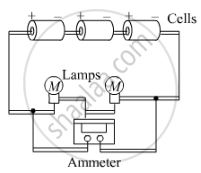
A student made an electric circuit shown here to measure the current through two lamps.
Are the lamps in series or parallel?
(a) Are the lamps in series or parallel?
(b) The student has made a mistake in this circuit. What is the mistake?
(c) Draw a circuit diagram to show the correct way to connect the circuit. Use the proper circuit symbols in your diagram.
State the factors on which the strength of electric current flowing in a given conductor depends.
V1, V2 and V3 are the p.ds. across the 1Ω, 2Ω and 3Ω resistors in the following diagram, and the current is 5 A.
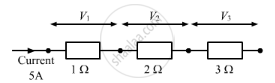
Which one of the columns (a) to (d) shows the correct values of V1, V2 and V3measured in volts?
`V_1` `V_2` `V_3`
(a) 1.0 2.0 3.0
(b) 5.0 10.0 15.0
(c) 5.0 2.5 1.6
(d) 4.0 4.0 2.0
Which type of circuit, series or parallel, is preferred while connecting a large number of bulbs:
(a) for decorating a hotel building from outside?
Find the potential difference required to pass a current of 0.2 A in a wire of resistance 20Ω
State the relation between work, charge and potential difference for an electric circuit.
Define the following:
Electromotive force
Fig. shows a 3 pin plug with the cover removed. The electric cable
connected to the plug contains 3 wires with colour coded insulation namely brown, blue and green.
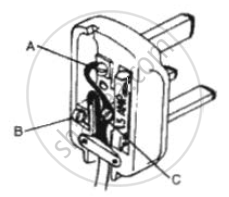
- Identify each of the colour coded wires by stating to which of the
terminals A, B or C in the diagram they should be connected. - Identify the terminal through which no current passes in normal
circumstances. - What is the purpose of the earthed wire connected to an electric
appliance like an electric heater? Describe how it works.
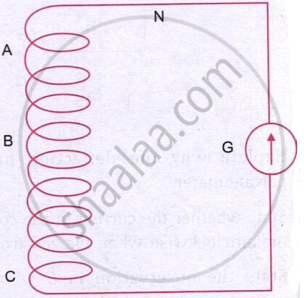
A strong short bar magnet is dropped into a solenoid connected to a
galvanometer as shown in fig. The galvanometer shows a deflection to the left when the current in the coil as seen from above is counter clockwise. Which one of the following shows the correct deflection of the galvanometer when the magnet is at posi tions A, Band C.
Electrical power P is given by the expression P = (Q × V) ÷ time
(a) What do the symbols Q and V represent?
(b) Express the power P in terms of current and resistance explaining the meanings of symbols used there in.
An electric bulb is rated '100 W, 250 V'. How much current will the bulb draw if connected to a 250 V supply?
- What is meant by electric current?
- Name and define its unit.
- Which instrument is used to measure the electric current? How should it be connected in a circuit?
Problems for practice:
If 3A current flows through a circuit, then convert the current in terms of a milliampere.
Match the items in column-I to the items in column-II:
| Column - I | Column - II |
| (i) electric current | (a) volt |
| (ii) potential difference | (b) ohm meter |
| (iii) specific resistance | (c) watt |
| (iv) Electrical power | (d) joule |
| (v) electrical energy | (e) ampere |
Electric current flows through a circuit only when:
In the process of current flow through a conductor, the amount of charge passing per unit time gives:
