Advertisements
Advertisements
प्रश्न
A 4 Ω coil and a 2 Ω coil are connected in parallel. What is their combined resistance? A total current of 3 A passes through the coils. What current passes through the 2 Ω coil?
Advertisements
उत्तर
The coils of the resistors of 4 Ω and 2 Ω are connected in parallel. Therefore:
`1/R=1/R_1+1/R_2`
`1/R=1/4+1/2`
`1/R=3/4`
`R=4/3`Ω
Combined resistance of the 4 Ω coil and the 2 Ω coil = 1.33 Ω
Total current = 3 A
The voltage across the whole cicuit,as in case of parallel circuit volatge is same scross all resistances.
V = IR.
V = 3 x 4/3 = 4 V
Therefore, the current through the 2 Ω coil,
I = V/R1.
I = 4/2 A
I = 2 A
APPEARS IN
संबंधित प्रश्न
With a neat labelled diagram and derive the equation for three resistances connected in parallel.
The equivalent resistance of the parallel combination of two resistors of 60Ω and 40Ω is _______.
A) 24Ω
(B) 100Ω
(C) 50 Ω
(D) 240Ω
Show how would you join three resistors, each of resistance 9 Ω so that the equivalent resistance of the combination is
1) 13.5
2) 6 Ω
State the law of combination of resistances in parallel.
Explain with diagram what is meant by the "series combination" and "parallel combination" of resistances. In which case the resultant resistance is : (i) less, and (ii) more, than either of the individual resistances?
In the diagram shown alongside, the cell and the ammeter both have negligible resistance. The resistors are identical.
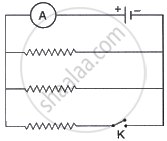
With the switch K open, the ammeter reads 0.6 A. What will be the ammeter reading when the switch is closed?
How will you connect three resistors of resistances 2 Ω, 3 Ω, and 6 Ω to obtain a total resistance of 4 Ω, and 1 Ω?
If current flows through two lamps arranged:
(a) in series,
(b) in parallel,
and the filament of one lamps breaks, what happens to the other lamp? Explain your answer.
Four resistors each of resistance 2Ω are connected in parallel. What is the effective resistance?
Explain, why is the p.d. between the terminals of a storage battery less when it is supplying current than when it is on open circuit. A battery of e.m.f. 10 volts and internal resistance 2.5 ohms has two resistances of 50 ohms each connected to it. Calculate the power dissipated in each resistance
(a) When they are in series,
(b) When they are in parallel.
In each case calculate the power dissipated in the battery.
Two resistors of resistance 4 Ω and 6 Ω are connected in parallel to a cell to draw 0.5 A current from the cell.
Draw a labeled diagram of the arrangement
An electrical appliance has a rating 100 W, 120V. The resistance of element of appliance when in use:
An electrical appliance having a resistance of 200 Ω is operated at 200 V. Calculate the energy consumed by the appliance in 5 minutes in kWh.
How does the resistance of a metallic wire depend on the thickness of wire?
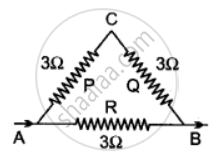
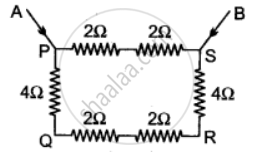
Calculate equivalent resistance in the following cases:
What connection is used in domestic appliances and why?
Two devices are connected between two points say A and B in parallel. The physical quantity that will remain the same between the two points is:

The diagram above is a schematic diagram of a household circuit. The house shown in the above diagram has 5 usable spaces where electrical connections are made. For this house, the mains have a voltage of 220 V and the net current coming from the mains is 22A.
- What is the mode of connection to all the spaces in the house from the mains?
- The spaces 5 and 4 have the same resistance and spaces 3 and 2 have respective resistances of 20Ω and 30Ω. Space 1 has a resistance double that of space 5. What is the net resistance for space 5.
- What is the current in space 3?
- What should be placed between the main connection and the rest of the house’s electrical appliances to save them from accidental high electric current?
Two V-I graphs A and B for series and parallel combinations of two resistors are as shown. Giving reason state which graph shows (a) series, (b) parallel combination of the resistors.

A particular resistance wire has a resistance of 3·0 ohm per metre. Find the resistance of 5 m length of a wire of the same material, but with twice the area of cross section.
