Advertisements
Advertisements
प्रश्न
Show how would you join three resistors, each of resistance 9 Ω so that the equivalent resistance of the combination is
1) 13.5
2) 6 Ω
Advertisements
उत्तर
1) Case: To get equivalent resistance = 13.5 Ω
For this case, two 9 Ω resistors should be first connected in parallel and then their combination should be connected in series with the remaining 9 Ω resistor. Thus,
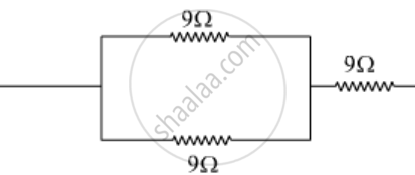
`R = (9xx9)/(9+9) = 81/18` = 4.5 Ω

`R_"total"` = R + 9 = 4.5 + 9 = 13.5 Ω
2) Case: To get equivalent resistance = 6 Ω
For this case, two 9 Ω resistors should be first connected in series and then this combination should be connected in parallel with the remaining 9 Ω resistor. Thus,
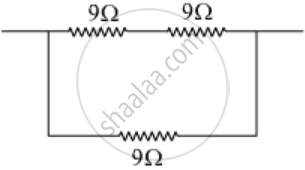
R1 = 9 + 9 = 18 Ω
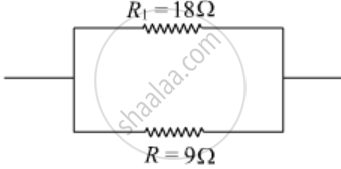
`R_"total" = (R_1xxR)/(R_1+R) = (18xx9)/(18+9)` = 6 Ω
APPEARS IN
संबंधित प्रश्न
Show how you would connect two 4 ohm resistors to produce a combined resistance of (a) 2 ohms (b) 8 ohms.
Show with the help of diagrams, how you would connect three resistors each of resistance 6 Ω, so that the combination has resistance of (i) 9 Ω (ii) 4 Ω.
A battery of e.m.f 16 V and internal resistance 2 Ω is connected to two resistors 3Ω and 6Ω connected in parallel. Find:
- the current through the battery.
- p.d. between the terminals of the battery,
- the current in 3 Ω resistors,
- the current in 6 Ω resistor.
A particular resistance wire has a resistance of 3 ohm per meter. Find the potential difference of the battery which gives a current of 2 A in each of the 1.5 m length when connected in the parallel to the battery (assume that resistance of the battery is negligible).
A particular resistance wire has a resistance of 3 ohm per meter. Find :
The total resistance of three lengths of this wire each 1.5 m long, in parallel.
A current of 2 A is passed through a coil of resistance 75 Ω for 2 minutes.
(a) How much heat energy is produced?
(b) How much charge is passed through the resistance?
How does the resistance of a metallic wire depend on the thickness of wire?
A given wire is stretched to double its length. How will its resistance change?
A piece of wire having a resistance R is cut into five equal parts.
- How will the resistance of each part of the wire change compared with the original resistance?
- If the five parts of the wire are placed in parallel, how will the resistance of the combination change?
- What will be ratio of the effective resistance in series connection to that of the parallel connection?
