Advertisements
Advertisements
प्रश्न
Show how would you join three resistors, each of resistance 9 Ω so that the equivalent resistance of the combination is
1) 13.5
2) 6 Ω
Advertisements
उत्तर
1) Case: To get equivalent resistance = 13.5 Ω
For this case, two 9 Ω resistors should be first connected in parallel and then their combination should be connected in series with the remaining 9 Ω resistor. Thus,
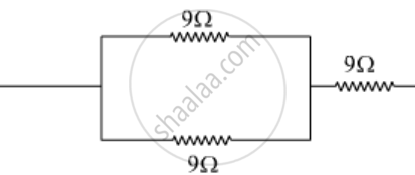
`R = (9xx9)/(9+9) = 81/18` = 4.5 Ω

`R_"total"` = R + 9 = 4.5 + 9 = 13.5 Ω
2) Case: To get equivalent resistance = 6 Ω
For this case, two 9 Ω resistors should be first connected in series and then this combination should be connected in parallel with the remaining 9 Ω resistor. Thus,
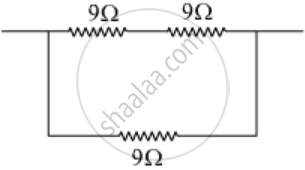
R1 = 9 + 9 = 18 Ω
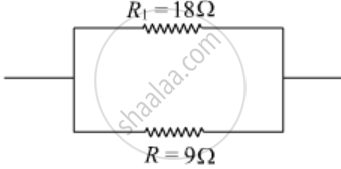
`R_"total" = (R_1xxR)/(R_1+R) = (18xx9)/(18+9)` = 6 Ω
APPEARS IN
संबंधित प्रश्न
With a neat labelled diagram and derive the equation for three resistances connected in parallel.
An electric lamp of 100 Ω, a toaster of resistance 50 Ω, and a water filter of resistance 500 Ω are connected in parallel to a 220 V source. What is the resistance of an electric iron connected to the same source that takes as much current as all three appliances, and what is the current through it?
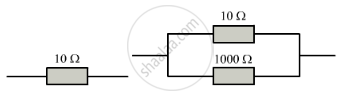
Which of the following arrangement, A or B, has the lower combined resistance?
A 4 Ω coil and a 2 Ω coil are connected in parallel. What is their combined resistance? A total current of 3 A passes through the coils. What current passes through the 2 Ω coil?
Explain, why is the p.d. between the terminals of a storage battery less when it is supplying current than when it is on open circuit. A battery of e.m.f. 10 volts and internal resistance 2.5 ohms has two resistances of 50 ohms each connected to it. Calculate the power dissipated in each resistance
(a) When they are in series,
(b) When they are in parallel.
In each case calculate the power dissipated in the battery.
Two resistors of resistance 4 Ω and 6 Ω are connected in parallel to a cell to draw 0.5 A current from the cell.
Draw a labeled diagram of the arrangement
Calculate equivalent resistance in the following cases:
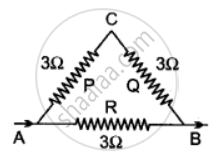
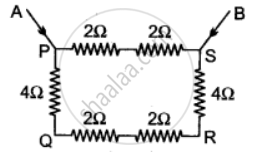
Three resistors of 1 Ω, 2 Ω and 3 Ω are connected in parallel. The combined resistance of the three resistors should be:
Three resistors of 6Ω, 4Ω and 4Ω are connected together so that the total resistance is 8Ω. Draw a diagram to show this arrangement and give reason to justify your answer.
Study the following circuit:

On the basis of this circuit, answer the following questions:
i. Find the value of total resistance between the points A and B.
ii. Find the resistance between the points B and C.
iii. Calculate the current drawn from the battery, when the key is closed
OR
iii. In the above circuit, the 16Ω resistor or the parallel combination of two resistors of 8 Ω, which one of the two will have more potential difference across its two ends? Justify your answer.
