Advertisements
Advertisements
प्रश्न
Write Joule's law of heating.
State and explain Joule's law of heating.
Advertisements
उत्तर
Joule's law of heating: When a current (I) flows through a resistor of resistance (R) for time (t), then the amount of heat produced (H) is given by
H = I2Rt
This is known as Joule’s law of heating.
APPEARS IN
संबंधित प्रश्न
An electric iron of resistance 20 Ω takes a current of 5 A. Calculate the heat developed in 30 s.
Name any two effects of electric current.
What is nichrome? State its one use.
How much heat will an instrument of 12 W produce in one minute if it is connected to the heat produced by it?
The heat produced by passing an electric current through a fixed resistor is proportional to the square of:
(a) magnitude of resistance of the resistor
(b) temperature of the resistor
(c) magnitude of current
(d) time for which current is passed
The heat produced in a wire of resistance 'x' when a current 'y' flows through it in time 'z' is given by:
(a) x2 × y × z
(b) x × z × y2
(c) y × z2 × x
(d) y × z × x
The electrical resistivities of four materials P, Q, R and S are given below:
| P | `6.84xx10^8`Ωm |
| Q | `1.70xx10^8`Ωm |
| R | ` 1.0xx10^15`Ωm |
| s | `11.0xx10^-7`Ωm |
Which material will you use for making: (a) heating element of electric iron (b) connecting wires of electric iron (c) covering of connecting wires? Give reason for your choice in each case.
Name the factors on which the heat produced in a wire depends when current is passed in it, and state how does it depend on the factors stated by you.
The electricity bill specifies the usage in _______.
A coil of an alloy _______ is used in electric heater cooker as a resistor.
Write two devices based on the heating effect of electric current.
Heating effect of current is called ______
Assertion: Bending of wire decreases the resistance of the electric wire.
Reason: The resistance of a conductor depends on length, thickness, nature of material and temperature of the conductor.
Three incandescent bulbs of 100 W each are connected in series in an electric circuit. In another circuit another set of three bulbs of the same wattage are connected in parallel to the same source.
- Will the bulb in the two circuits glow with the same brightness? Justify your answer.
- Now let one bulb in both the circuits get fused. Will the rest of the bulbs continue to glow in each circuit? Give reason.
Unscramble the following words:
SFEU
Your teacher has shown you the following activity.
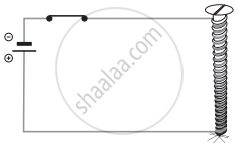
Activity: Teacher has wound a long insulated piece of wire around an iron nail in the form of a coil. Free ends of the wire are connected to a cell through a switch as shown in the following figure. The current is switched on and some pins are placed near the ends of the nail.
Write down any three questions that come to your mind about this activity.
The following is not a safety device.
In a set up the students coated iron nails with zinc metal and noted that, iron nails coated with zinc prevents rusting. They also observed that zinc initially acts as a physical barrier, but an extra advantage of using zinc is that it continues to prevent rusting even if the layer of zinc is damaged. Name this process of rust prevention and give any two other methods to prevent rusting.
The graph of voltage vs current for four different materials is shown below.

Which of these four materials would be used for making filament of bulb?
