Advertisements
Advertisements
Question
Show how would you join three resistors, each of resistance 9 Ω so that the equivalent resistance of the combination is
1) 13.5
2) 6 Ω
Advertisements
Solution
1) Case: To get equivalent resistance = 13.5 Ω
For this case, two 9 Ω resistors should be first connected in parallel and then their combination should be connected in series with the remaining 9 Ω resistor. Thus,
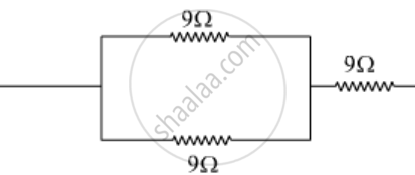
`R = (9xx9)/(9+9) = 81/18` = 4.5 Ω

`R_"total"` = R + 9 = 4.5 + 9 = 13.5 Ω
2) Case: To get equivalent resistance = 6 Ω
For this case, two 9 Ω resistors should be first connected in series and then this combination should be connected in parallel with the remaining 9 Ω resistor. Thus,
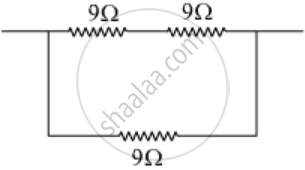
R1 = 9 + 9 = 18 Ω
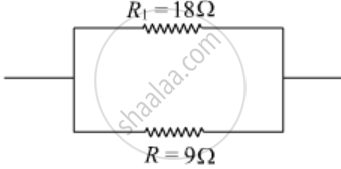
`R_"total" = (R_1xxR)/(R_1+R) = (18xx9)/(18+9)` = 6 Ω
APPEARS IN
RELATED QUESTIONS
Complete the following :-
(b)
Several electric bulbs designed to be used on a 220 V electric supply line are rated 10 W. How many lamps can be connected in parallel with each other across the two wires of 220 V line if the maximum allowable current is 5 A?
Which of the following arrangement, A or B, has the lower combined resistance?
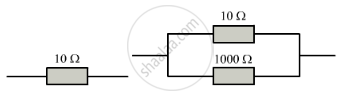
Explain with diagram what is meant by the "series combination" and "parallel combination" of resistances. In which case the resultant resistance is : (i) less, and (ii) more, than either of the individual resistances?
How will you connect three resistors of 2 Ω, 3 Ω and 5 Ω respectively so as to obtain a resultant of 2.5 Ω? Draw the diagram to show the arrangement.
State how are the two resistors joined with a battery when equivalent resistance is less than either of the two resistances.
In parallel combination of resistances ______.
A cell supplies a current of 1.2 A through two 2Ω resistors connected in parallel. When the resistors are connected in series, if supplies a current of 0.4 A. Calculate the internal resistance and e.m.f of the cell.
A current of 2 A is passed through a coil of resistance 75 Ω for 2 minutes.
(a) How much heat energy is produced?
(b) How much charge is passed through the resistance?
A piece of wire having a resistance R is cut into five equal parts.
- How will the resistance of each part of the wire change compared with the original resistance?
- If the five parts of the wire are placed in parallel, how will the resistance of the combination change?
- What will be ratio of the effective resistance in series connection to that of the parallel connection?
