Advertisements
Advertisements
Question
A student uses a lens of focal length 40 cm and another of –20 cm. Write the nature and power of each lens
Advertisements
Solution
Power of first lens, `P_1 = 1/(f(m)) = 1/0.4 = 2.5 D`
The given lens is a converging lens i.e. a convex lens.
Power of second lens, `P_2 = 1/f(m)` = `-1/0.2` = -5D
The given lens is a diverging lens i.e. a concave lens.
APPEARS IN
RELATED QUESTIONS
State the power of a lens S.I. unit.
Which one of the following materials cannot be used to make a lens?
How is the power of a lens related to its focal length?
A convex lens of focal length 25 cm and a concave lens of focal length 10 cm are placed in close contact with one another.
(a) What is the power of this combination?
(b) What is the focal length of this combination?
(c) Is this combination converging or diverging?
A normal eye is not able to see objects closer than 25 cm because
Consider three converging lenses L1, L2 and L3 having identical geometrical construction. The index of refraction of L1 and L2 are \[\mu_1 \text{ and } \mu_2\] respectively. The upper half of the lens L3 has a refractive index \[\mu_1\] and the lower half has \[\mu_2\] following figure . A point object O is imaged at O1 by the lens L1 and at O2 by the lens L2placed in same position. If L3 is placed at the same place,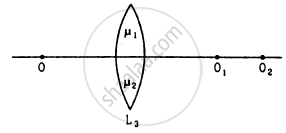
(a) there will be an image at O1
(b) there will be an image at O2.
(c) the only image will form somewhere between O1 and O2
(d) the only image will form away from O2.
How is accommodation produced?
If there is a convex lens of focal length 75 cm and a concave lens of focal length 40 cm, then calculate their combined power and combined focal length.
Define power of a lens. What is its unit? One student uses a lens of focal length 50 cm and another of –50 cm. What is the nature of the lens and its power used by each of them?
A point object is placed at O in front of a glass sphere as shown in figure.

Show the formation of the image by the sphere.
