Advertisements
Advertisements
Question
Differentiate between resistances in series and parallel.
Advertisements
Solution
| Resistances in Series | Resistances in Parallel | ||
| 1 | In this type of connection, the resistances are connected one after the other such that the same amount of current flows through each resistance. | 1 | In this type of connection, the resistances are connected between two common points such that the potential difference across each resistor is the same. |
| 2 | For n number of resistors connected in series, the effective resistance RS is equal to the sum of the individual resistors. RS = R1 + R2 + R3 + R4+ …… Rn |
2 |
For n number of resistors connected in pparallel, the reciprocal of the effective resistance (Rp) is equal to the sum of the reciprocals of the individual resistances. `1/R_p=1/R_1+1/R_2+..............+1/R_p`
|
| 3 | The effective resistance in series combination is greater than the individual resistances. | 3 | The effective resistance in parallel combination is less than the individual resistances in the combination. |
| 4 | It is used to decrease the current in the circuit. | 4 | It is used to increase the current in the circuit. |
APPEARS IN
RELATED QUESTIONS
Complete the following :-
(c)

Which of the following arrangement, A or B, has the lower combined resistance?
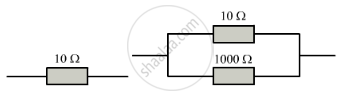
In the circuit given below:
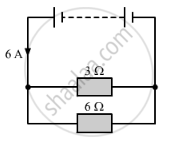
(a) What is the combined resistance?
(b) What is the p.d. across the combined resistor?
(c) What is the p.d. across the 3 Ω resistor?
(d) What is the current in the 3 Ω resistor?
(e) What is the current in the 6 Ω resistor?
A resistor of 8 ohms is connected in parallel with another resistor X. The resultant resistance of the combination is 4.8 ohms. What is the value of the resistor X?
A particular resistance wire has a resistance of 3 ohm per meter. Find the total resistance of three lengths of this wire each 1.5 m long, joined in parallel.
A uniform wire with a resistance of 27 Ω is divided into three equal pieces and then they are joined in parallel. Find the equivalent resistance of the parallel combination.
A battery of e.m.f. 15 V and internal resistance 2 `Omega` is connected to two resistors of 4 ohm and 6 ohm joined.
(i) In series,
(ii) In parallel.
Find in each case the electrical energy spent per minute in 6 ohm resistor.
Show how would you connect three resistors, each of resistance 6 O so that
the combination has a resistance of(a) 9 Ω (b) 4 .Ω
Two resistors of resistance 4 Ω and 6 Ω are connected in parallel to a cell to draw 0.5 A current from the cell.
Calculate current in each resistor.
An electrical appliance has a rating 100 W, 120V. The resistance of element of appliance when in use:
A given wire is stretched to double its length. How will its resistance change?
Calculate equivalent resistance in the following cases:
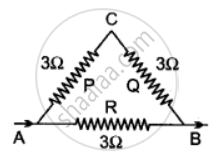
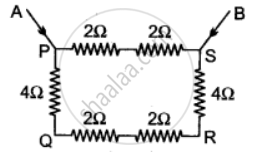
A piece of wire having a resistance R is cut into five equal parts.
- How will the resistance of each part of the wire change compared with the original resistance?
- If the five parts of the wire are placed in parallel, how will the resistance of the combination change?
- What will be ratio of the effective resistance in series connection to that of the parallel connection?
The least resistance obtained by using 2 Ω, 4 Ω, 1 Ω and 100 Ω is:
A coil in the heater consumes power P on passing current. If it is cut into halves and joined in parallel, it will consume power:
Two resistors having resistance 8 Ω and 12 Ω are connected in parallel. Find their equivalent resistance.
Four resistors each of resistance 5 Ω are connected in parallel. What is the effective resistance?
Two resistors of resistances 2 Ω and 3 Ω are connected in parallel to a cell to draw current 0.5 A from the cell. Draw a labelled diagram of the arrangement
