Advertisements
Advertisements
Question
Two V-I graphs A and B for series and parallel combinations of two resistors are as shown. Giving reason state which graph shows (a) series, (b) parallel combination of the resistors.

Advertisements
Solution
We know that V = IR or `1/"R"=1/"V"=` slope of graph given.
The resistance increases as the slope decreases. Graph B clearly has a greater slope than graph A. As a result, B has less resistance than A. As far as we are aware, combined series resistance is consistently greater than combined parallel resistance. As a result, A and B are series and parallel combinations, respectively.
APPEARS IN
RELATED QUESTIONS
A hot plate of an electric oven connected to a 220 V line has two resistance coils A and B, each of 24 Ω resistances, which may be used separately, in series, or in parallel. What are the currents in the three cases?
Find the current in each resistor in the circuit shown below:
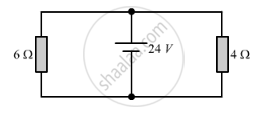
Two resistors, with resistance 5 Ω and 10 Ω respectively are to be connected to a battery of emf 6 V so as to obtain:
(i) minimum current flowing
(ii) maximum current flowing
(a) How will you connect the resistances in each case?
(b) Calculate the strength of the total current in the circuit in the two cases.
A resistor of 8 ohms is connected in parallel with another resistor X. The resultant resistance of the combination is 4.8 ohms. What is the value of the resistor X?
Two exactly similar electric lamps are arranged (i) in parallel, and (ii) in series. If the parallel and series combination of lamps are connected to 220 V supply line one by one, what will be the ratio of electric power consumed by them?
State how are the two resistors joined with a battery when potential difference is same across each resistor.
Which of the following combinations have the same equivalent resistance between X and Y?
The equivalent resistance of a parallel combination of two resistors of 30 Ω and 60 Ω is ______________.
Three resistors of 1 Ω, 2 Ω and 3 Ω are connected in parallel. The combined resistance of the three resistors should be:
Two resistors of resistances 2 Ω and 3 Ω are connected in parallel to a cell to draw current 0.5 A from the cell. Draw a labelled diagram of the arrangement
