Advertisements
Advertisements
Question
Draw a ray diagram for concave mirror when the object is between centre of curvature and focus.
Advertisements
Solution
When the object is between the centre of curvature and the focus of a concave mirror
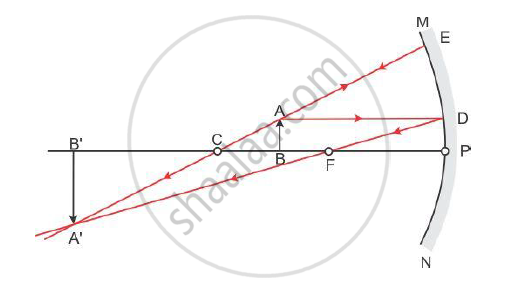
Here, Object AB is kept between C and F
First, we draw a ray parallel to principal axis
So, it passes through focus after reflection
We draw another ray which passes through Center of Curvature
So, the ray will go back along the same path after reflection
Where both reflected rays meet is point A'
And the image formed is A'B'
This image is formed between beyong Center(C)
We can say that
Image is in Front of the mirror (Real image)
Image is Inverted
Image is larger than the object (Magnified)
APPEARS IN
RELATED QUESTIONS
It is desired to obtain an erect image of an object, using concave mirror of focal length of 12 cm.
What should be the range of distance of an object placed in front of the mirror?
The image formed by a concave mirror is observed to be virtual, erect and larger than the object. Where should be the position of the object?
Fill in the following blank with suitable word:
The focal length of a concave mirror is the distance from the ......... to the mirror.
Draw a ray diagram showing how a concave mirror can be used to produce a real, inverted and diminished image of an object.
State where an object must be placed so that the image formed by a concave mirror is:
(b) at infinity.
(c) the same size as the object.
Make labelled ray diagrams to illustrate the formation of:
a virtual image by a converging mirror.
Mark clearly the pole, focus, centre of curvature and position of object in each case.
Briefly describe how you would find the focal length of a concave mirror quickly but approximately
The real image formed by a concave mirror is larger than the object when object is:
(a) at a distance equal to radius of curvature
(b) at a distance less than the focal length
(c) between focus and centre of curvature
(d) at a distance greater than radius of curvature
An object 3 cm high is placed at a distance of 10 cm in front of a converging mirror of focal length 20 cm. Find the position, nature, and size of the image formed.
How far should an object be placed from the pole of a converging mirror of focal length 20cm to form a real image of the size exactly `1/4`th the size of the object?
A concave mirror produces a real image 1 cm tall of an object 2.5 mm tall placed 5 cm from the mirror. Find the position of the image and the focal length of the mirror.
In the following diagram. MM' is a concave mirror and AB is an object. Draw on your answer-sheet a ray diagram to show the formation of image of this object.
Draw the ray diagram and also state the position, the relative size and the nature of image formed by a concave mirror when the object is placed at the centre of curvature of the mirror.
Concave mirrors are used by dentists to examine teeth. Why?
Rays from Sun converge at a point 15 cm in front of a concave mirror. Where should an object be placed so that size of its image is equal to the size of the object?
In which of the following, the image of an object placed at infinity will be highly diminished and point sized?
An erect and enlarged image can be formed by
In the headlights of motor vehicles, ______ mirrors are used as reflectors.
Between which two points of a concave mirror should an object be placed to obtain a magnification of -2?
