Advertisements
Advertisements
प्रश्न
Draw a ray diagram for concave mirror when the object is between centre of curvature and focus.
Advertisements
उत्तर
When the object is between the centre of curvature and the focus of a concave mirror
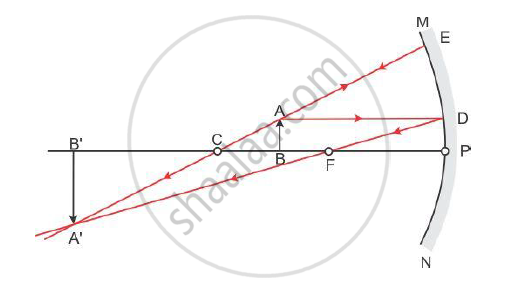
Here, Object AB is kept between C and F
First, we draw a ray parallel to principal axis
So, it passes through focus after reflection
We draw another ray which passes through Center of Curvature
So, the ray will go back along the same path after reflection
Where both reflected rays meet is point A'
And the image formed is A'B'
This image is formed between beyong Center(C)
We can say that
Image is in Front of the mirror (Real image)
Image is Inverted
Image is larger than the object (Magnified)
APPEARS IN
संबंधित प्रश्न
If the image formed by a mirror for all positions of the object placed in front of it is always erect and diminished, what type of mirror is it? Draw a ray diagram to justify your answer. Where and why do we generally use this type of mirror?
An object of height 5 cm is placed perpendicular to the principal axis of a concave lens of focal length 10 cm. If the distance of the object from the optical centre of the lens is 20 cm, determine the position, nature and size of the image formed using the lens formula.
A student has obtained the image of a distant object with a concave mirror to determine its focal length. If he has selected a well-illuminated red building as object, which of the following correctly describes the features of the image formed?
(A) Virtual, inverted and diminished image in red shade
(B) Real, erect and diminished image in pink shade
(C) Real, inverted and diminished image in red shade
(D) Virtual, erect and enlarged image in red shade
A ray of light is incident on a plane mirror making an angle of 90° with the mirror surface. The angle of reflection for this ray of light will be:
(a) 45°
(b) 90°
(c) 0°
(d) 60°
For a convex mirror, parallel rays of light appear to diverge from a point called the ______.
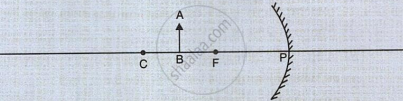
Draw the following diagram in your answer book and show the formation of image of the object AB with the help of suitable rays:
Explain why, a ray of light passing through the centre of curvature of a concave mirror gets reflected back along the same path.
If an object is placed at a distance of 8 cm from a concave mirror of focal length 10 cm, discuss the nature of the image formed by drawing the ray diagram.
Make labelled ray diagrams to illustrate the formation of:
- a real image by a converging mirror.
- a virtual image by a converging mirror.
Mark clearly the pole, focus, centre of curvature and position of object in each case.
An object is placed at the following distances from a concave mirror of focal length 15 cm, turn by turn:
(a) 35 cm
(b) 30 cm
(c) 20 cm
(d) 10 cm
Which position of the object will produce:
(i) a magnified real image?
(ii) a magnified virtual image?
(iii) a diminished real image?
(iv) an image of same size as the object?
When an object is placed at a distance of 15 cm from a concave mirror, its image is formed at 10 cm in front of the mirror. Calculate the focal length of the mirror.
A large concave mirror has a radius of curvature of 1.5 m. A person stands 10 m in front of the mirror. Where is the person's image?
Why are concave mirrors used in solar devices?
Answer the following question:
An object is placed at a distance of 30 cm from a concave lens of focal length 30 cm.
(i) Use the lens formula to determine the distance of the image from the lens.
(ii) List four characteristics of the image (nature, position, size, erect/inverted) in this case.
(iii) Draw a labelled diagram to justify your answer of the part (ii)
List four characteristics of the image formed by a concave mirror of focal length 40 cm when the object is placed in front of it at a distance of 20 cm from its pole.
You are provided with a concave mirror, a convex mirror, a concave lens and a convex lens. To obtain an enlarged image of an object you can use either
The ENT doctor uses a ______.
______ mirrors magnify the object placed close to them.
