Advertisements
Advertisements
प्रश्न
Draw a ray diagram to show the formation of image of an object placed between the pole and focus of a concave mirror. State the position, size and nature of the image.
Advertisements
उत्तर
OBJECT LIES BETWEEN FOCUS AND POLE :

A virtual erect and bigger image is formed behind the mirror
Image formed A’B’ is on the other side of the mirror on producing ← position
Enlarged (magnified) ← size
Virtual and erect ← nature
APPEARS IN
संबंधित प्रश्न
Draw a ray diagram to show the path of the refracted ray in each of the following cases:-
A ray of light incident on a concave lens is
(i) passing through its optical centre.
(ii) parallel to its principal axis.
(iii) directed towards its principal focus.
List four characteristics of the images formed by plane mirrors.
What is a spherical mirror?
Draw the following diagram in your answer book and show the formation of image with the help of suitable rays:
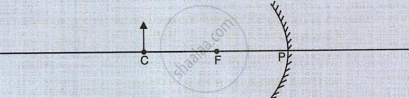
A concave mirror produces a real image 1 cm tall of an object 2.5 mm tall placed 5 cm from the mirror. Find the position of the image and the focal length of the mirror.
An object is 24 cm away from a concave mirror and its image is 16 cm from the mirror. Find the focal length and radius of curvature of the mirror, and the magnification of the image.
What would your image look like if you stood close to a large:
concave mirror?
Name the lens which can concentrate sun's rays to a point and burn a hole in a piece of paper.
Study the following ray diagram and list two mistakes committed by the student while tracing it. Rectify these mistakes by drawing the correct ray diagram to show the real position and size of the image corresponding to the position of the object AB.

Large ______ mirrors are used to concentrate sunlight to produce heat in solar furnaces.
