Advertisements
Advertisements
प्रश्न
Draw a ray diagram to show the formation of image of an object placed on the principal axis of a convex mirror. State the position, size and nature of the image. What happens to the image as the object is moved away from the mirror?
Advertisements
उत्तर
OBJECT PLACED IN FRONT OF CONVEX MIRROR :

Place the object anywhere in front of convex mirror image formed is
- Between pole and focus ← position.
- Diminished ← size.
- Upright (erect) and virtual ← nature.
As the object is moved away from the mirror, the image shifts towards the focus and decreases in size but is (diminished)
APPEARS IN
संबंधित प्रश्न
A spherical mirror and a thin spherical lens have each a focal length of -15 cm. The mirror and the lens are likely to be ______.
Copy this figure in your answer book and show the direction of the light ray after reflection:

What is the minimum number of rays required for locating the image formed by a concave mirror for an object? Draw a ray diagram to show the formation of a virtual image by a concave mirror.
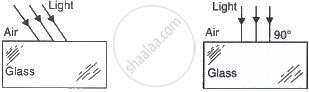
Draw and complete the following diagrams to show what happens to the beams of light as they enter the glass block and then leave it:
In which equipment/s do you find ___________________
Consider the following properties of virtual images:
- cannot be projected on the screen
- are formed by both concave and convex lens
- are always erect
- are always inverted
The correct properties are:
Answer the following question:
An object is placed at a distance of 30 cm from a concave lens of focal length 30 cm.
(i) Use the lens formula to determine the distance of the image from the lens.
(ii) List four characteristics of the image (nature, position, size, erect/inverted) in this case.
(iii) Draw a labelled diagram to justify your answer of the part (ii)
Rays from Sun converge at a point 15 cm in front of a concave mirror. Where should an object be placed so that size of its image is equal to the size of the object?
Identify the device used as a spherical mirror or lens in following case, when the image formed is virtual and erect in case.
Object is placed between device and its focus, image formed is enlarged and behind it.
Write the uses of the concave mirror.
