Advertisements
Advertisements
प्रश्न
How can a concave mirror be used to obtain a virtual image of an object? Draw a diagram to illustrate your answer.
Advertisements
उत्तर
A concave mirror forms a virtual image of an object when the object is placed between focus and mirror (pole)
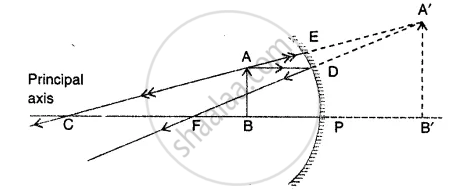
A virtual, erect and bigger image is formed behind the mirror
APPEARS IN
संबंधित प्रश्न
If an object is placed at the focus of a concave mirror, where is the image formed?
Explain why, a ray of light passing through the centre of curvature of a concave mirror gets reflected back along the same path.
With the help of a labelled diagram, explain how a concave lens diverges a beam of parallel light rays. Mark the principal axis, optical centre, principal focus and focal length of the concave lens on the diagram.
To find the focal length of a concave mirror Rahul focuses a distant object with this mirror. The chosen object should be
(1) a tree
(2) a building
(3) a window
(4) the sun
Why does obtaining the image of the sun on paper with the help of a concave mirror burn the paper?
Answer the following question:
An object is placed at a distance of 30 cm from a concave lens of focal length 30 cm.
(i) Use the lens formula to determine the distance of the image from the lens.
(ii) List four characteristics of the image (nature, position, size, erect/inverted) in this case.
(iii) Draw a labelled diagram to justify your answer of the part (ii)
The mirror used by the ophthalmologist to examine the eye is _______.
The mirror having reflecting surface curved inwards ______.
An erect and enlarged image can be formed by
To obtain an image twice the size of the object, between which two points related to a concave mirror should an object be placed?
