Advertisements
Advertisements
प्रश्न
How can a concave mirror be used to obtain a virtual image of an object? Draw a diagram to illustrate your answer.
Advertisements
उत्तर
A concave mirror forms a virtual image of an object when the object is placed between focus and mirror (pole)
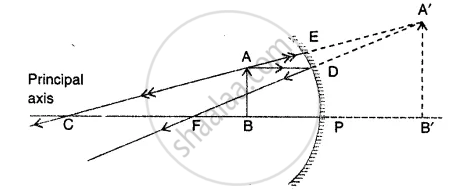
A virtual, erect and bigger image is formed behind the mirror
APPEARS IN
संबंधित प्रश्न
Name the mirror that can give an erect and enlarged image of an object.
With the help of a labelled ray diagram, describe how a converging mirror can be used to give an enlarged upright image of an object.
Describe the nature of image formed when the object is placed at a distance of 20 cm from a concave mirror of focal length 10 cm
What would your image look like if you stood close to a large:
concave mirror?
A concave mirror cannot be used as:
(a) a magnifying mirror
(b) a torch reflector
(c) a dentist's mirror
(d) a real view mirror
The mirror having reflecting surface curved inwards ______.
A concave mirror of focal length 20 cm forms an image having twice the size of object. For the virtual position of object, the position of object will be at ______.
Which of the following mirror is used by a dentist to examine a small cavity in a patient’s teeth?
You are provided with a convex mirror, a concave mirror, a convex lens and a concave lens. You can get an inverted image from
Which type of mirror is used in the following?
Shaving mirror
