Advertisements
Advertisements
Question
How can a concave mirror be used to obtain a virtual image of an object? Draw a diagram to illustrate your answer.
Advertisements
Solution
A concave mirror forms a virtual image of an object when the object is placed between focus and mirror (pole)
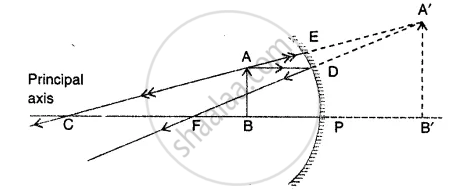
A virtual, erect and bigger image is formed behind the mirror
APPEARS IN
RELATED QUESTIONS
A student wants to project the image of a candle flame on a screen 48 cm in front of a mirror by keeping the flame at a distance of 12 cm from its pole.
(a) Suggest the type of mirror he should use.
(b) Find the linear magnification of the image produced.
(c) How far is the image from its object?
(d) Draw ray diagram to show the image formation in this case.
Which type of mirror is used in a solar furnace? Support your answer with reason.
Give two uses of concave mirrors. Explain why you would choose concave mirrors for these uses.
A concave mirror produces a real image 1 cm tall of an object 2.5 mm tall placed 5 cm from the mirror. Find the position of the image and the focal length of the mirror.
An object is 24 cm away from a concave mirror and its image is 16 cm from the mirror. Find the focal length and radius of curvature of the mirror, and the magnification of the image.
An object is placed at a large distance in front of a concave mirror of radius of curvature 40 cm. The image will be formed in front of the mirror at a distance:
(a) 20 cm
(b) 30 cm
(c) 40 cm
(d) 50 cm
In which equipment/s do you find ___________________
Rays from Sun converge at a point 15 cm in front of a concave mirror. Where should an object be placed so that size of its image is equal to the size of the object?
The ENT doctor uses a ______.
The image formed by a concave mirror is real, inverted and of the same size as that of the object, the position of the object should be ______.
