Advertisements
Advertisements
प्रश्न
Describe the positions of the source of light with respect to a concave mirror in Projector lamp.
Advertisements
उत्तर
In a projector lamp, the light source is at the centre of the curvature of a concave mirror, which produces an image of the shape of the object itself.
APPEARS IN
संबंधित प्रश्न
With the help of an appropriate ray diagram, state the sign conventions for reflection by a spherical mirror.
If the image formed by a mirror for all positions of the object placed in front of it is always erect and diminished, what type of mirror is it? Draw a ray diagram to justify your answer. Where and why do we generally use this type of mirror?
Consider the following diagram in which M is a mirror and P is an object and Q is its magnified image formed by the mirror.
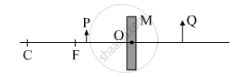
State the type of the mirror M and one characteristic property of the image Q.
The image formed by a concave mirror is observed to be virtual, erect and larger than the object. Where should the position of the object be relative to the mirror? Draw ray diagram to justify your answer.
Name the mirror that can give an erect and enlarged image of an object.
An object of size 7.0 cm is placed at 27 cm in front of a concave mirror of focal length 18 cm. At what distance from the mirror should a screen be placed, so that a sharp focused image can be obtained? Find the size and the nature of the image.
Which type of mirror is used by a dentist?
Find the focal length of a concave mirror whose radius of curvature is 32 cm.
Fill in the following blank with suitable word:
The focal length of a concave mirror is the distance from the ......... to the mirror.
Draw the following diagram in your answer book and show the formation of image of the object AB with the help of suitable rays:
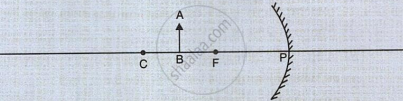
Which mirror is used as a torch reflector? Draw a labelled diagram to show how a torch reflector can be used to produce a parallel beam of light. Where is the bulb placed in relation to the torch reflector?
The image formed by a concave mirror is real, inverted and highly diminished (much smaller than the object). The object must be:
(a) between pole and focus
(b) at focus
(c) at the centre of curvature
(d) at infinity
The focal length of a small concave mirror is 2.5 cm. In order to use this concave mirror as a dentist's mirror, the distance of tooth from the mirror should be:
(a) 2.5 cm
(b) 1.5 cm
(c) 4.5 cm
(d) 3.5 cm
According to the "New Cartesian Singh Convention" for mirrors, what sign has been given to the focal length of:
a convex mirror?
Giving reasons, state the 'signs' (positive or negative) which can be given to the following:
(a) object distance (u) for a concave mirror or convex mirror
(b) image distance (v) for a concave mirror
(c) image distance (v) for a convex mirror
An object is placed at a distance of 10 cm from a concave mirror of focal length 20 cm.
State two characteristics of the image formed.
An object 3 cm high is placed at a distance of 10 cm in front of a converging mirror of focal length 20 cm. Find the position, nature, and size of the image formed.
If the object is moved further away from the mirror, what changes are there in the position and size of the image?
At what distance from a concave mirror of focal length 10 cm should an object be placed so that:
its real image is formed 20 cm from the mirror?
What type of image/images are formed by:
a convex mirror?
Name the mirror which can give:
an erect and enlarged image of an object.
Name the lens which can concentrate sun's rays to a point and burn a hole in a piece of paper.
If the radius of curvature of a concave mirror is 20 cm, its focal length is:
Draw a ray diagram to show the formation of image of an object placed at the centre of curvature of a concave mirror. State the position, size and nature of the image.
Draw a ray diagram to show the formation of image of an object placed between the focus and centre of curvature of a concave mirror. State the position, size and nature of the image.
How can a concave mirror be used to obtain a virtual image of an object? Draw a diagram to illustrate your answer.
In the following diagram. MM' is a concave mirror and AB is an object. Draw on your answer-sheet a ray diagram to show the formation of image of this object.
Consider the following properties of virtual images:
- cannot be projected on the screen
- are formed by both concave and convex lens
- are always erect
- are always inverted
The correct properties are:
Match the following.
| Convex mirror | Radio telescopes |
| Parobolic mirror | Rear – view mirror |
| Snell’s law | Kaleidoscope |
| Dispersion of light | sin i/sin r =μ |
| Refractive index | Rainbow |
According to cartesion sign convention, which mirror and which lens has negative focal length?
Pick out the concave and convex mirrors from the following and tabulate them.
Rear-view mirror, Dentist’s mirror, Torchlight mirror, Mirrors in shopping malls, Make-up mirror.
An object at a distance of 30 cm from a
concave mirror gets its image at the same point. The focal length of the mirror is ______.

While looking at the above diagram, Nalini concluded the following.
- the image of the object will be a virtual one.
- the reflected ray will travel along the same path as the incident ray but in opposite direction.
- the image of the object will be inverted.
- this is a concave mirror and hence the focal length will be negative.
Which one of the above statements are correct?
Rays from Sun converge at a point 15 cm in front of a concave mirror. Where should an object be placed so that size of its image is equal to the size of the object?
______ mirrors magnify the object placed close to them.
Define principal focus of the concave mirror.
Which type of mirror is used in the following?
Floodlights
