Advertisements
Advertisements
प्रश्न
Describe the positions of the source of light with respect to a concave mirror in Projector lamp.
Advertisements
उत्तर
In a projector lamp, the light source is at the centre of the curvature of a concave mirror, which produces an image of the shape of the object itself.
APPEARS IN
संबंधित प्रश्न
Draw a ray diagram to show the path of the reflected ray corresponding to an incident ray of light parallel to the principal axis of a convex mirror and show the angle of incidence and angle of reflection on it.
A student obtained a sharp image of a candle flame placed at the distant end of the laboratory table on a screen using a concave mirror to determine its focal length. The teacher suggested him to focus a distant building, about 1 km away from the laboratory, for getting more correct value of the focal length. In order to focus the distant building on the same screen, the student should slightly move the
(a) mirror away from the screen
(b) screen away from the mirror
(c) screen towards the mirror
(d) screen towards the building
Study the following diagram and select the correct statement about the device 'X' :
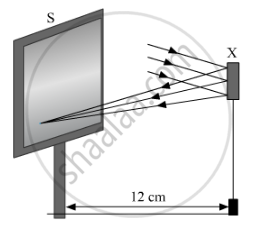
(A) Device 'X' is a concave mirror of radius of curvature 12 cm
(B) Device 'X' is a concave mirror of focal length 6 cm
(C) Device 'X' is a concave mirror of focal length 12 cm
(D) Device 'X' is a convex of mirror of focal length 12 cm
The image formed by a concave mirror is observed to be virtual, erect and larger than the object. Where should the position of the object be relative to the mirror? Draw ray diagram to justify your answer.
A student wants to project the image of a candle flame on a screen 48 cm in front of a mirror by keeping the flame at a distance of 12 cm from its pole.
(a) Suggest the type of mirror he should use.
(b) Find the linear magnification of the image produced.
(c) How far is the image from its object?
(d) Draw ray diagram to show the image formation in this case.
A student has obtained the image of a distant object with a concave mirror to determine its focal length. If he has selected a well-illuminated red building as object, which of the following correctly describes the features of the image formed?
(A) Virtual, inverted and diminished image in red shade
(B) Real, erect and diminished image in pink shade
(C) Real, inverted and diminished image in red shade
(D) Virtual, erect and enlarged image in red shade
A concave mirror produces three times magnified (enlarged) real image of object placed at 10 cm in front of it. Where is the image located?
To construct a ray diagram we use two rays which are so chosen that it is easy to know their directions after reflection from the mirror. List two such rays and state the path of these rays after reflection in case of concave mirrors. Use these two rays and draw ray diagram to locate the image of an object placed between pole and focus of a concave mirror.
Three students A, B and C focussed a distant building on a screen with the help of a concave mirror. To determine focal length of the concave mirror they measured the distances as given below:
Student A : From mirror to the screen
Student B : From building to the screen
Student C : From building to the mirror
Who measured the focal length correctly ;
(a) Only A
(b) Only B
(c) A and B
(d) B and C
A 3 cm tall object is placed 18 cm in front of a concave mirror of focal length 12 cm. At what distance from the mirror should a screen be placed to see a sharp image of the object on the screen. Also calculate the height of the image formed.
Out of convex mirror and concave mirror, whose focus is situated behind the mirror?
A concave mirror ______ rays of light whereas a convex mirror ______ rays of light.
For what position of an object, a real and diminished image is formed by a concave mirror?
What is the minimum number of rays required for locating the image formed by a concave mirror for an object? Draw a ray diagram to show the formation of a virtual image by a concave mirror.
With the help of a labelled ray diagram, describe how a converging mirror can be used to give an enlarged upright image of an object.
Give two uses of concave mirrors. Explain why you would choose concave mirrors for these uses.
One of the following does not apply to a concave mirror this is:
(a) focal length is negative
(b) image distance can be positive or negative
(c) image distance is always positive
(d) height of image can be positive or negative
An object 3 cm high is placed at a distance of 8 cm from a concave mirror which produces a virtual image 4.5 cm high:
(i) What is the focal length of the mirror?
(ii) What is the position of image?
(iii) Draw a ray-diagram to show the formation of image.
An object 3 cm high is placed at a distance of 10 cm in front of a converging mirror of focal length 20 cm. Find the position, nature, and size of the image formed.
A bright object 50 mm high stands on the axis of a concave mirror of focal length 100 mm and at a distance of 300 mm from the concave mirror. How big will the image be?
A man holds a spherical shaving mirror of radius of curvature 60 cm, and focal length 30 cm, at a distance of 15 cm, from his nose. Find the position of image, and calculate the magnification.
If the object is moved further away from the mirror, what changes are there in the position and size of the image?
At what distance from a concave mirror of focal length 10 cm should an object be placed so that:
- its real image is formed 20 cm from the mirror?
- its virtual image is formed 20 cm from the mirror?
Name the mirror which can give:
an erect and enlarged image of an object.
The mirror which can form a magnified image of an object is:
(a) convex mirror
(b) plane mirror
(c) concave mirror
(d) both convex and concave mirror
With the help of a labelled diagram, explain how a concave lens diverges a beam of parallel light rays. Mark the principal axis, optical centre, principal focus and focal length of the concave lens on the diagram.
A student determines the focal length of a device 'X' by focusing the image of a distant object on a screen placed 20 cm from the device on the same side as the object. The device 'X' is
(a) Concave lens of focal length 10 cm
(b) Convex lens of focal length 20 cm
(c) Concave mirror of focal length 10 cm
(d) Concave mirror of focal length 20 cm
Why does obtaining the image of the sun on paper with the help of a concave mirror burn the paper?
Consider the following properties of virtual images:
- cannot be projected on the screen
- are formed by both concave and convex lens
- are always erect
- are always inverted
The correct properties are:
List four characteristics of the image formed by a concave mirror of focal length 40 cm when the object is placed in front of it at a distance of 20 cm from its pole.
Match the following.
| Convex mirror | Radio telescopes |
| Parobolic mirror | Rear – view mirror |
| Snell’s law | Kaleidoscope |
| Dispersion of light | sin i/sin r =μ |
| Refractive index | Rainbow |
Pick out the concave and convex mirrors from the following and tabulate them.
Rear-view mirror, Dentist’s mirror, Torchlight mirror, Mirrors in shopping malls, Make-up mirror.
A concave mirror of focal length 20 cm forms an image having twice the size of object. For the virtual position of object, the position of object will be at ______.
Identify the device used as a spherical mirror or lens in following case, when the image formed is virtual and erect in case.
Object is placed between device and its focus, image formed is enlarged and behind it.
An erect and enlarged image can be formed by
You are provided with a convex mirror, a concave mirror, a convex lens and a concave lens. You can get an inverted image from
Define principal focus of the concave mirror.
