Advertisements
Advertisements
Questions
Describe the positions of the source of light with respect to a concave mirror in Projector lamp.
Advertisements
Solution
In a projector lamp, the light source is at the centre of the curvature of a concave mirror, which produces an image of the shape of the object itself.
APPEARS IN
RELATED QUESTIONS
It is desired to obtain an erect image of an object, using concave mirror of focal length of 12 cm.
What should be the range of distance of an object placed in front of the mirror?
Draw the following diagram in which a ray of light is incident on a concave/convex mirror on your answer sheet. Show the path of this ray, after reflection, in each case.

Study the following diagram and select the correct statement about the device 'X' :
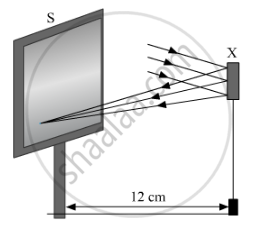
(A) Device 'X' is a concave mirror of radius of curvature 12 cm
(B) Device 'X' is a concave mirror of focal length 6 cm
(C) Device 'X' is a concave mirror of focal length 12 cm
(D) Device 'X' is a convex of mirror of focal length 12 cm
To construct ray diagrams, two rays of light are generally so chosen that it is easy to determine their directions after reflection from a mirror. Choose two such rays and state the path/direction of these rays after reflection from a concave mirror. Use these two rays to find the position and nature of the image of an object placed at a distance of 8 cm from a concave mirror of focal length 12 cm.
A spherical mirror and a thin spherical lens have each a focal length of -15 cm. The mirror and the lens are likely to be ______.
Name the type of mirror used in the following situation:
Headlights of a car
Support your answer with reason.
Draw diagram to represent the action of a concave mirror on a beam of parallel light rays. Mark on this diagram principal axis, focus F, centre of curvature C, pole P and focal length f, of the concave mirror.
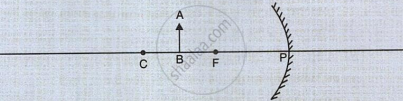
Draw the following diagram in your answer book and show the formation of image of the object AB with the help of suitable rays:
Explain why, concave mirrors are used as shaving mirrors.
In the concave reflector of a torch, the bulb is placed:
(a) between the pole and focus of reflector
(b) at the focus of reflector
(c) between focus and centre of curvature of reflector
(d) at the centre of curvature of reflector
An object is 100 mm in front of a concave mirror which produces an upright (erect image). The radius of curvature of the mirror is ______.
A concave mirror has a focal length of 25 cm. At which of the following distance should a person hold his face from this concave mirror so that it may act as a shaving mirror?
(a) 45 cm
(b) 20 cm
(c) 25 cm
(d) 30 cm
Give reason for your choice.
Describe the nature of image formed when the object is placed at a distance of 20 cm from a concave mirror of focal length 10 cm
An object 3 cm high is placed at a distance of 10 cm in front of a converging mirror of focal length 20 cm. Find the position, nature, and size of the image formed.
A concave mirror produces three times enlarged virtual image of an object placed at 10 cm in front of it. Calculate the radius of curvature of the mirror.
A concave mirror produces a real image 1 cm tall of an object 2.5 mm tall placed 5 cm from the mirror. Find the position of the image and the focal length of the mirror.
What would your image look like if you stood close to a large:
concave mirror?
The mirror used by a dentist to examine the teeth of a person is ______.
A concave mirror cannot be used as:
(a) a magnifying mirror
(b) a torch reflector
(c) a dentist's mirror
(d) a real view mirror
Which of the following can make a parallel beam of light from a bulb falls on it?
(a) concave mirror as well as concave lens
(b) convex mirror as well as concave lens
(c) concave mirror as well as convex lens
(d) concave mirror as well as convex lens
Draw a ray diagram to show the formation of the image of an object placed beyond the centre of curvature of a concave mirror. State the position, size and nature of the image.
Draw a ray diagram to show the formation of image of an object placed between the pole and focus of a concave mirror. State the position, size and nature of the image.
How can a concave mirror be used to obtain a virtual image of an object? Draw a diagram to illustrate your answer.
State two uses of a concave mirror.
A student obtained a sharp image of the grills of a window on a screen using a concave mirror. His teacher remarked that for getting better results a well lit distant object (preferably the sun) should be focussed on the screen. What should be done for this purpose?
(A) Move the screen slightly away from the mirror
(B) Move the mirror slightly towards the screen
(C) Move the screen and the mirror away from the object
(D) Move the screen and the mirror towards the object
Why are concave mirrors used in solar devices?
In which equipment/s do you find ___________________
According to cartesion sign convention, which mirror and which lens has negative focal length?
Beams of light are incident through the holes A and B and emerge out of box through the holes C and D respectively as shown in the figure. Which of the following could be inside the box?

The mirror having reflection surface curved outward ______.
A concave mirror produces a magnification of +4. The object is placed ______.
For a real object, which of the following can produce a real image?
The image formed by a concave mirror is real, inverted and of the same size as that of the object, the position of the object should be ______.
Define principal focus of the concave mirror.
Write the uses of the concave mirror.
A student wants to obtain an erect image of an object using a concave mirror of 10 cm focal length. What will be the distance of the object from mirror?
Which type of mirror is used in the following?
Floodlights
