Advertisements
Advertisements
Questions
Describe the positions of the source of light with respect to a concave mirror in Torch light.
Advertisements
Solution
In a Torch, the light source is at the hub of a concave mirror, which gives you parallel light.
APPEARS IN
RELATED QUESTIONS
To determine the approximate value of the focal length of a given concave mirror, you focus the image of a distant object formed by the mirror on a screen. The image obtained on the serene, as compared to the object is always:
(a) Laterally inverted and diminished
(b) Inverted and diminished
(c) Erect and diminished
(d) Erect and highly diminished
To construct a ray diagram we use two rays of light which are so chosen that it is easy to determine their directions after reflection from the mirror. Choose these two rays and state the path of these rays after reflection from a concave mirror. Use these two rays to find the nature and position of the image of an object placed at a distance of 15 cm from a concave mirror of focal length 10 cm.
A spherical mirror produces an image of magnification −1 on a screen placed at a distance of 40 cm from the mirror:
(i) Write the type of mirror.
(ii) What is the nature of the image formed?
(iii) How far is the object located from the mirror?
(iv) Draw the ray diagram to show the image formation in this case.
A spherical mirror produces an image of magnification -1.0 on a screen placed at a distance of 30 cm from the pole of the mirror.
(i) Write the type of mirror in this case.
(ii) What is the focal length of the mirror ?
(iii) What is the nature of the image formed ?
(iv) Draw the ray diagram to show the image formation in this case.
A spherical mirror and a thin spherical lens have each a focal length of -15 cm. The mirror and the lens are likely to be ______.
Find the focal length of a concave mirror whose radius of curvature is 32 cm.
Draw diagram to represent the action of a concave mirror on a beam of parallel light rays. Mark on this diagram principal axis, focus F, centre of curvature C, pole P and focal length f, of the concave mirror.
A communications satellite in orbit sends a parallel beam of signals down to earth. If these signals obey the same laws of reflection as light and are to be focussed onto a small receiving aerial, what should be the best shape of the metal 'dish' used to collect them?
For what position of an object, a concave mirror forms a real image equal in size to the object?
If an object is at infinity (very large distance) in front of a concave mirror, where is the image formed?
Described with the help of a diagram, the nature, size and position of the image formed when an object is placed beyond the centre of curvature of a concave mirror.
Explain why, concave mirrors are used as shaving mirrors.
In the concave reflector of a torch, the bulb is placed:
(a) between the pole and focus of reflector
(b) at the focus of reflector
(c) between focus and centre of curvature of reflector
(d) at the centre of curvature of reflector
An object is 100 mm in front of a concave mirror which produces an upright (erect image). The radius of curvature of the mirror is ______.
A concave mirror has a focal length of 25 cm. At which of the following distance should a person hold his face from this concave mirror so that it may act as a shaving mirror?
(a) 45 cm
(b) 20 cm
(c) 25 cm
(d) 30 cm
Give reason for your choice.
An object is placed at the following distances from a concave mirror of focal length 15 cm, turn by turn:
(a) 35 cm
(b) 30 cm
(c) 20 cm
(d) 10 cm
Which position of the object will produce:
(i) a magnified real image?
(ii) a magnified virtual image?
(iii) a diminished real image?
(iv) an image of same size as the object?
According to the "New Cartesian Singh Convention" for mirrors, what sign has been given to the focal length of:
a convex mirror?
Write down a formula for the magnification produced by a concave mirror.
In terms of height of object and height of image.
An object 3 cm high is placed at a distance of 10 cm in front of a converging mirror of focal length 20 cm. Find the position, nature, and size of the image formed.
A concave mirror produces a real image 1 cm tall of an object 2.5 mm tall placed 5 cm from the mirror. Find the position of the image and the focal length of the mirror.
What type of mirror should be used as a shaving mirror?
Which of the following are concave mirrors and which convex mirrors?
Shaving mirrors, Car headlight mirror, Searchlight mirror, Driving mirror, Dentist’s inspection mirror, Torch mirror, Staircase mirror in a double-decker bus, Make-up mirror, Solar furnace mirror, Satellite TV dish, Shop security mirror.
The diagram shows a dish antenna which is used to receive television signals from a satellite. The antenna (signal detector) is fixed in front of the curved dish.
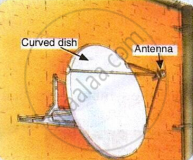
- What is the purpose of the dish?
- Should it be concave or convex?
- Where should the antenna be positioned to receive the strongest possible signals?
- Explain what change you would expect in the signals if a larger dish was used.
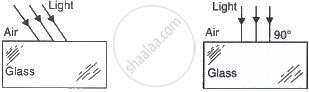
Draw and complete the following diagrams to show what happens to the beams of light as they enter the glass block and then leave it:
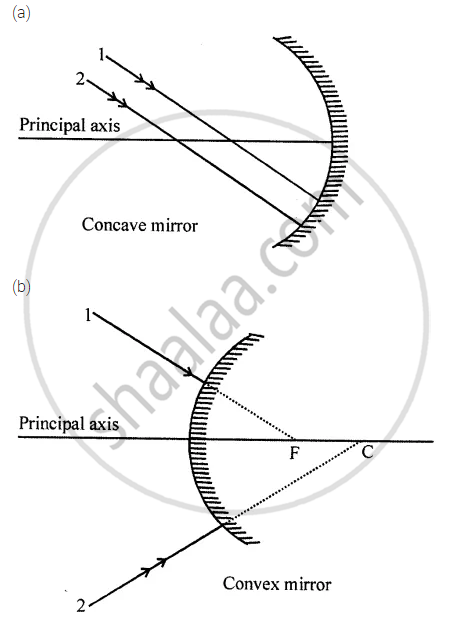
Complete the following diagrams in figure by drawing the reflected rays for the incident rays 1 and 2 if F is the focus and C is the centre of curvature.
To find the focal length of a concave mirror Rahul focuses a distant object with this mirror. The chosen object should be
(1) a tree
(2) a building
(3) a window
(4) the sun
The mirror used by the ophthalmologist to examine the eye is _______.
Match the following.
| Convex mirror | Radio telescopes |
| Parobolic mirror | Rear – view mirror |
| Snell’s law | Kaleidoscope |
| Dispersion of light | sin i/sin r =μ |
| Refractive index | Rainbow |
Pick out the concave and convex mirrors from the following and tabulate them.
Rear-view mirror, Dentist’s mirror, Torchlight mirror, Mirrors in shopping malls, Make-up mirror.
A 10 mm long awl pin is placed vertically in front of a concave mirror. A 5 mm long image of the awl pin is formed at 30 cm in front of the mirror. The focal length of this mirror is ______.
Under which of the following conditions a concave mirror can form an image larger than the actual object?
Rays from Sun converge at a point 15 cm in front of a concave mirror. Where should an object be placed so that size of its image is equal to the size of the object?
In which of the following, the image of an object placed at infinity will be highly diminished and point sized?
A concave mirror of focal length 20 cm forms an image having twice the size of object. For the virtual position of object, the position of object will be at ______.
Which of the following mirror is used by a dentist to examine a small cavity in a patient’s teeth?
The concave reflecting surface of a torch got rusted. What effect would this have on the beam of light from the torch?
In torches, searchlights, and headlights of vehicles, the bulb is placed ______ of the concave mirror.
To obtain an image twice the size of the object, between which two points related to a concave mirror should an object be placed?
A student wants to obtain an erect image of an object using a concave mirror of 10 cm focal length. What will be the distance of the object from mirror?
A student took three concave mirrors of different focal lengths and performed the experiment to see the image formation by placing an object at different distance with these mirrors as shown in the following table.
| Case No. | Object-distance | Focal length |
| I | 45 cm | 20 cm |
| II | 30 cm | 15 cm |
| III | 20 cm | 30 cm |
Now answer the following questions:
(a) List two properties of the image formed in Case I.
(b) In which one of the cases given in the table, the mirror will form real image of same size and why?
(c) Name the type of mirror used by dentists. Given reason why do they use such type of mirrors.
OR
(c) Look at the table and identify the situation (object distance and focal length) which resembles the situation in which concave mirrors are used as shaving mirrors? Draw a ray diagram to show the image formation in this case.
