Advertisements
Advertisements
Question
With the help of an appropriate ray diagram, state the sign conventions for reflection by a spherical mirror.
Advertisements
Solution
The sign convention for reflection by spherical mirrors is as follows:-
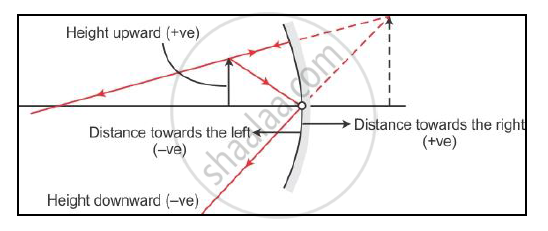
- The object is always placed to the left of the mirror.
- All distances parallel to the principal axis are measured from the pole of the mirror.
- All the distances measured to the right of the origin are taken as positive, while those measured to the left of the origin are taken as negative.
- Distances measured perpendicular to and above the principal axis are taken as positive.
- Distances measured perpendicular to and below the principal axis are taken as negative.
- The focal length of a convex mirror is positive, while that of a concave mirror is negative.
APPEARS IN
RELATED QUESTIONS
Draw a ray diagram for concave mirror when the object is between centre of curvature and focus.
Draw a ray diagram to show the path of the refracted ray in each of the following cases:-
A ray of light incident on a concave lens is
(i) passing through its optical centre.
(ii) parallel to its principal axis.
(iii) directed towards its principal focus.
A student wants to project the image of a candle flame on a screen 48 cm in front of a mirror by keeping the flame at a distance of 12 cm from its pole.
(a) Suggest the type of mirror he should use.
(b) Find the linear magnification of the image produced.
(c) How far is the image from its object?
(d) Draw ray diagram to show the image formation in this case.
Draw a ray diagram to show the path of the reflected ray corresponding to an incident ray of light parallel to the principal axis of a concave mirror. Mark the angle of incidence and angle of reflection on it.
A spherical mirror produces an image of magnification -1.0 on a screen placed at a distance of 30 cm from the pole of the mirror.
(i) Write the type of mirror in this case.
(ii) What is the focal length of the mirror ?
(iii) What is the nature of the image formed ?
(iv) Draw the ray diagram to show the image formation in this case.
A concave mirror produces three times magnified (enlarged) real image of object placed at 10 cm in front of it. Where is the image located?
Which type of mirror is used by a dentist?
If an object is placed at the focus of a concave mirror, where is the image formed?
State where an object must be placed so that the image formed by a concave mirror is:
(b) at infinity.
(c) the same size as the object.
Which type of mirror is used in a solar furnace? Support your answer with reason.
An object is placed at the following distances from a concave mirror of focal length 15 cm, turn by turn:
(a) 35 cm
(b) 30 cm
(c) 20 cm
(d) 10 cm
Which position of the object will produce:
(i) a magnified real image?
(ii) a magnified virtual image?
(iii) a diminished real image?
(iv) an image of same size as the object?
An object is placed at a large distance in front of a concave mirror of radius of curvature 40 cm. The image will be formed in front of the mirror at a distance:
(a) 20 cm
(b) 30 cm
(c) 40 cm
(d) 50 cm
Why does a beam of light when it enters glass at an angle? Why does it not bend if it inters the glass at right angles?
Radius of curvature of a spherical mirror is ............. its focal length.
Draw the ray diagram and also state the position, the relative size and the nature of image formed by a concave mirror when the object is placed at the centre of curvature of the mirror.
A _____________ mirror is used by a dentist.
The radius of curvature of a concave mirror whose focal length is 5cm is ______
Concave mirrors are used by dentists to examine teeth. Why?
______ mirrors magnify the object placed close to them.
