Advertisements
Advertisements
Questions
Describe the positions of the source of light with respect to a concave mirror in Floodlight.
Advertisements
Solution
In a floodlight, the light source is slightly beyond the radius of curvature, which gives us the right light.
APPEARS IN
RELATED QUESTIONS
Draw the following diagram in which a ray of light is incident on a concave/convex mirror on your answer sheet. Show the path of this ray, after reflection, in each case.

A student obtained a sharp image of a candle flame placed at the distant end of the laboratory table on a screen using a concave mirror to determine its focal length. The teacher suggested him to focus a distant building, about 1 km away from the laboratory, for getting more correct value of the focal length. In order to focus the distant building on the same screen, the student should slightly move the
(a) mirror away from the screen
(b) screen away from the mirror
(c) screen towards the mirror
(d) screen towards the building
Study the following diagram and select the correct statement about the device 'X' :
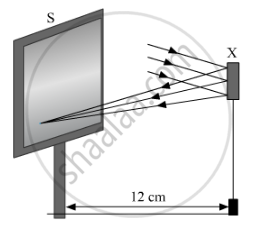
(A) Device 'X' is a concave mirror of radius of curvature 12 cm
(B) Device 'X' is a concave mirror of focal length 6 cm
(C) Device 'X' is a concave mirror of focal length 12 cm
(D) Device 'X' is a convex of mirror of focal length 12 cm
The image formed by a concave mirror is observed to be virtual, erect and larger than the object. Where should the position of the object be relative to the mirror? Draw ray diagram to justify your answer.
Draw a ray diagram to show the path of the reflected ray corresponding to an incident ray of light parallel to the principal axis of a concave mirror. Mark the angle of incidence and angle of reflection on it.
Name the mirror that can give an erect and enlarged image of an object.
The image formed by a concave mirror is observed to be virtual, erect and larger than the object. Where should be the position of the object?
A concave mirror produces three times magnified image on a screen. If the object is placed 20 cm in front of the mirror, how far is the screen from the object.
If the focal length of a convex mirror is 25 cm, what is its radius of curvature?
Fill in the following blank with suitable word:
The focal length of a concave mirror is the distance from the ......... to the mirror.
For a convex mirror, parallel rays of light appear to diverge from a point called the ______.
For what position of an object, a real and diminished image is formed by a concave mirror?
Copy this figure in your answer book and show the direction of the light ray after reflection:
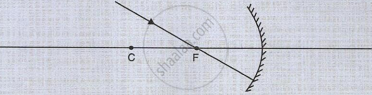
With the help of a ray diagram, determine the position, nature and size of the image formed of an object placed at the centre of curvature of a concave mirror.
Described with the help of a diagram, the nature, size and position of the image formed when an object is placed beyond the centre of curvature of a concave mirror.
Draw a ray diagram showing how a concave mirror can be used to produce a real, inverted and diminished image of an object.
The real image formed by a concave mirror is smaller than the object if the object is:
(a) between centre of curvature and focus
(b) at a distance greater than radius of curvature
(c) at a distance equal to radius of curvature
(d) at a distance equal to focal length
The angle of incidence for of light passing through the centre of curvature of a concave mirror is:
(a) 45°
(b) 90°
(c) 0°
(d) 180°
According to the "New Cartesian Singh Convention" for mirrors, what sign has been given to the focal length of:
a convex mirror?
According to New Cartesian Sign Convention:
(a) focal length of concave mirror is positive and that of convex mirror is negative
(b) focal length of both concave and convex mirrors is positive
(c) focal length of both concave and convex mirrors is negative
(d) focal length of concave mirror is negative and that of convex mirror is positive
Write down a formula for the magnification produced by a concave mirror.
In terms of height of object and height of image.
A concave mirror has a focal length of 4 cm and an object 2 cm tall is placed 9 cm away from it. Find the nature, position and size of the image formed.
A concave mirror produces three times enlarged virtual image of an object placed at 10 cm in front of it. Calculate the radius of curvature of the mirror.
At what distance from a concave mirror of focal length 10 cm should an object be placed so that:
its real image is formed 20 cm from the mirror?
The diagram shows a dish antenna which is used to receive television signals from a satellite. The antenna (signal detector) is fixed in front of the curved dish.
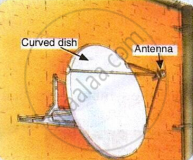
- What is the purpose of the dish?
- Should it be concave or convex?
- Where should the antenna be positioned to receive the strongest possible signals?
- Explain what change you would expect in the signals if a larger dish was used.
With the help of a labelled diagram, explain how a concave lens diverges a beam of parallel light rays. Mark the principal axis, optical centre, principal focus and focal length of the concave lens on the diagram.
Radius of curvature of a spherical mirror is ............. its focal length.
The image formed by a concave mirror is of the same size as the object, if the object is placed
How can a concave mirror be used to obtain a virtual image of an object? Draw a diagram to illustrate your answer.
State two uses of a concave mirror.
A student has to trace the path of a ray of light passing through a rectangular glass slab for four different values of angle of incidence.
(a) Write two important precautions for this experiment.
(b) List two conclusions the student will draw based on his experiment.
In which equipment/s do you find ___________________
Large ______ mirrors are used to concentrate sunlight to produce heat in solar furnaces.
Rays from Sun converge at a point 15 cm in front of a concave mirror. Where should an object be placed so that size of its image is equal to the size of the object?
State whether the following statement is True or False.
The sides of an object and its image formed by a concave mirror are always interchanged
The ENT doctor uses a ______.
What is a concave and convex mirror?
