Advertisements
Advertisements
Question
Which type of mirror is used by a dentist?
Options
Plane
Convex
Concave
Both Convex and Concave
Advertisements
Solution
Concave
APPEARS IN
RELATED QUESTIONS
If the image formed by a mirror for all positions of the object placed in front of it is always erect and diminished, what type of mirror is it? Draw a ray diagram to justify your answer. Where and why do we generally use this type of mirror?
Draw a ray diagram to show the path of the refracted ray in each of the following cases:-
A ray of light incident on a concave lens is
(i) passing through its optical centre.
(ii) parallel to its principal axis.
(iii) directed towards its principal focus.
State two positions in which a concave mirror produces a magnified image of a given object. List two differences between the two images.
Consider the following diagram in which M is a mirror and P is an object and Q is its magnified image formed by the mirror.
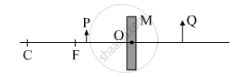
State the type of the mirror M and one characteristic property of the image Q.
Study the following diagram and select the correct statement about the device 'X' :
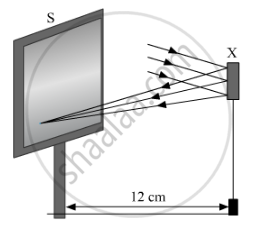
(A) Device 'X' is a concave mirror of radius of curvature 12 cm
(B) Device 'X' is a concave mirror of focal length 6 cm
(C) Device 'X' is a concave mirror of focal length 12 cm
(D) Device 'X' is a convex of mirror of focal length 12 cm
The radius of curvature of a spherical mirror is 20 cm. What is its focal length?
We wish to obtain an erect image of an object, using a concave mirror of focal length 15 cm. What should be the range of distance of the object from the mirror? What is the nature of the image? Is the image larger or smaller than the object? Draw a ray diagram to show the image formation in this case.
Find the focal length of a concave mirror whose radius of curvature is 32 cm.
For what position of an object, a real and diminished image is formed by a concave mirror?
With the help of a labelled ray diagram, describe how a converging mirror can be used to give an enlarged upright image of an object.
If the object is moved further away from the mirror, what changes are there in the position and size of the image?
The mirror used by a dentist to examine the teeth of a person is ______.
Draw a ray diagram to show the formation of image of an object placed at the centre of curvature of a concave mirror. State the position, size and nature of the image.
The radius of curvature of a concave mirror whose focal length is 5cm is ______
Large ______ mirrors are used to concentrate sunlight to produce heat in solar furnaces.
The mirror having reflecting surface curved inwards ______.
Which of the following mirror is used by a dentist to examine a small cavity in a patient’s teeth?
An erect and enlarged image can be formed by
The concave reflecting surface of a torch got rusted. What effect would this have on the beam of light from the torch?
Which type of mirror is used in the following?
Head lamps of a car
