Advertisements
Advertisements
Question
Draw a ray diagram to show the formation of image of an object placed at the centre of curvature of a concave mirror. State the position, size and nature of the image.
Advertisements
Solution
Object placed at C :

A real, inverted image of the same size is formed at the centre of curvature
Image formed
A ‘B’ is at C the centre of curvature.
Size is equal to the size of object AB.
It is inverted and real.
APPEARS IN
RELATED QUESTIONS
It is desired to obtain an erect image of an object, using concave mirror of focal length of 12 cm.
Where will the image of this object be, if it is placed 24 cm in front of the mirror? Draw ray diagram for this situation also justify your answer. Show the positions of pole, principal focus and the centre of curvature in the above ray diagrams
To construct a ray diagram we use two rays of light which are so chosen that it is easy to determine their directions after reflection from the mirror. Choose these two rays and state the path of these rays after reflection from a concave mirror. Use these two rays to find the nature and position of the image of an object placed at a distance of 15 cm from a concave mirror of focal length 10 cm.
A concave mirror ______ rays of light whereas a convex mirror ______ rays of light.
Giving reasons, state the 'signs' (positive or negative) which can be given to the following:
(a) object distance (u) for a concave mirror or convex mirror
(b) image distance (v) for a concave mirror
(c) image distance (v) for a convex mirror
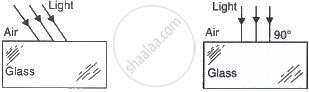
Draw and complete the following diagrams to show what happens to the beams of light as they enter the glass block and then leave it:
The radius of curvature of a concave mirror whose focal length is 5cm is ______
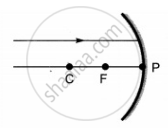
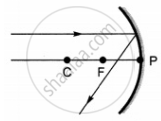
Which of the following ray diagrams is correct for the ray of light incident on a concave mirror as shown in figure?
 |
 |
 |
 |
| A | B | C | D |
The mirror having reflecting surface curved inwards ______.
In torches, searchlights, and headlights of vehicles, the bulb is placed ______ of the concave mirror.
Which type of mirror is used in the following?
Shaving mirror
