Advertisements
Advertisements
प्रश्न
Draw a ray diagram to show the formation of image of an object placed at the centre of curvature of a concave mirror. State the position, size and nature of the image.
Advertisements
उत्तर
Object placed at C :

A real, inverted image of the same size is formed at the centre of curvature
Image formed
A ‘B’ is at C the centre of curvature.
Size is equal to the size of object AB.
It is inverted and real.
APPEARS IN
संबंधित प्रश्न
A student wants to project the image of a candle flame on the walls of the school laboratory by using a mirror.
(a) Which type of mirror should he use and why?
(b) At what distance, in terms of focal length 'f' of the mirror, should he place the candle flame to get the magnified image on the wall?
(c) Draw a ray diagram to show the formation of the image in this case.
(d) Can he use this mirror to project a diminished image of the candle flame on the same wall? State 'how' if your answer is 'yes' and 'why not' if your answer is 'no.'
If an object is at infinity (very large distance) in front of a concave mirror, where is the image formed?
Which mirror is used as a torch reflector? Draw a labelled diagram to show how a torch reflector can be used to produce a parallel beam of light. Where is the bulb placed in relation to the torch reflector?
The image formed by a concave mirror is real, inverted and highly diminished (much smaller than the object). The object must be:
(a) between pole and focus
(b) at focus
(c) at the centre of curvature
(d) at infinity
According to the "New Cartesian Singh Convention" for mirrors, what sign has been given to the focal length of:
a convex mirror?
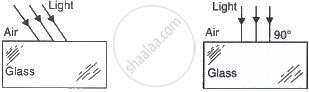
Draw and complete the following diagrams to show what happens to the beams of light as they enter the glass block and then leave it:
To find the focal length of a concave mirror Rahul focuses a distant object with this mirror. The chosen object should be
(1) a tree
(2) a building
(3) a window
(4) the sun
Match the following.
| Convex mirror | Radio telescopes |
| Parobolic mirror | Rear – view mirror |
| Snell’s law | Kaleidoscope |
| Dispersion of light | sin i/sin r =μ |
| Refractive index | Rainbow |
Explain the images formed by a concave mirror.
The image formed by concave mirror is real, inverted and of the same size as that of the object. The position of object should be ______.
