Advertisements
Advertisements
प्रश्न
Match the following.
| Convex mirror | Radio telescopes |
| Parobolic mirror | Rear – view mirror |
| Snell’s law | Kaleidoscope |
| Dispersion of light | sin i/sin r =μ |
| Refractive index | Rainbow |
Advertisements
उत्तर
| Convex mirror | Rear – view mirror |
| Parobolic mirror | Radio telescopes |
| Snell’s law | sin i/sin r =μ |
| Dispersion of light | Rainbow |
| Refractive index | Kaleidoscope |
APPEARS IN
संबंधित प्रश्न
If the image formed by a mirror for all positions of the object placed in front of it is always erect and diminished, what type of mirror is it? Draw a ray diagram to justify your answer. Where and why do we generally use this type of mirror?
Study the following diagram and select the correct statement about the device 'X' :
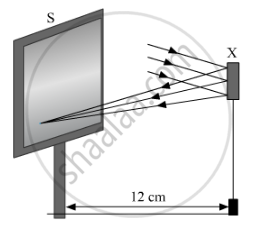
(A) Device 'X' is a concave mirror of radius of curvature 12 cm
(B) Device 'X' is a concave mirror of focal length 6 cm
(C) Device 'X' is a concave mirror of focal length 12 cm
(D) Device 'X' is a convex of mirror of focal length 12 cm
Fill in the following blank with suitable word:
The focal length of a concave mirror is the distance from the ......... to the mirror.
Giving reasons, state the 'signs' (positive or negative) which can be given to the following:
(a) object distance (u) for a concave mirror or convex mirror
(b) image distance (v) for a concave mirror
(c) image distance (v) for a convex mirror
An object 3 cm high is placed at a distance of 10 cm in front of a converging mirror of focal length 20 cm. Find the position, nature, and size of the image formed.
Why does a beam of light when it enters glass at an angle? Why does it not bend if it inters the glass at right angles?
Draw a ray diagram to show the formation of the image of an object placed beyond the centre of curvature of a concave mirror. State the position, size and nature of the image.
The radius of curvature of a concave mirror whose focal length is 5cm is ______
The concave reflecting surface of a torch got rusted. What effect would this have on the beam of light from the torch?
The image formed by a concave mirror is real, inverted and of the same size as that of the object, the position of the object should be ______.
