Advertisements
Advertisements
प्रश्न
Match the following.
| Convex mirror | Radio telescopes |
| Parobolic mirror | Rear – view mirror |
| Snell’s law | Kaleidoscope |
| Dispersion of light | sin i/sin r =μ |
| Refractive index | Rainbow |
Advertisements
उत्तर
| Convex mirror | Rear – view mirror |
| Parobolic mirror | Radio telescopes |
| Snell’s law | sin i/sin r =μ |
| Dispersion of light | Rainbow |
| Refractive index | Kaleidoscope |
APPEARS IN
संबंधित प्रश्न
Copy this figure in your answer book and show the direction of the light ray after reflection:
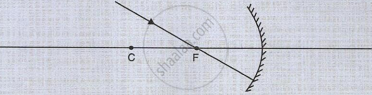
Explain why, a ray of light passing through the centre of curvature of a concave mirror gets reflected back along the same path.
The real image formed by a concave mirror is smaller than the object if the object is:
(a) between centre of curvature and focus
(b) at a distance greater than radius of curvature
(c) at a distance equal to radius of curvature
(d) at a distance equal to focal length
A converging mirror forms a real image of height 4 cm of an object of height 1 cm placed 20 cm away from the mirror:
- Calculate the image distance.
- What is the focal length of the mirror?
If the radius of curvature of a concave mirror is 20 cm, its focal length is:
In the following diagram. MM' is a concave mirror and AB is an object. Draw on your answer-sheet a ray diagram to show the formation of image of this object.
To construct ray diagram we use two light rays which are so chosen that it is easy to know their directions after reflection from the mirror. List these two rays and state the path of these rays after reflection. Use these rays to locate the image of an object placed between centre of curvature and focus of a concave mirror.
In which of the following, the image of an object placed at infinity will be highly diminished and point sized?
An object at a distance of 30 cm from a
concave mirror gets its image at the same point. The focal length of the mirror is ______.
