Advertisements
Advertisements
प्रश्न
According to cartesion sign convention, which mirror and which lens has negative focal length?
Advertisements
उत्तर
Concave mirror is having a negative focal length.
APPEARS IN
संबंधित प्रश्न
Study the following diagram and select the correct statement about the device 'X' :
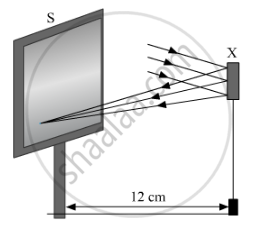
(A) Device 'X' is a concave mirror of radius of curvature 12 cm
(B) Device 'X' is a concave mirror of focal length 6 cm
(C) Device 'X' is a concave mirror of focal length 12 cm
(D) Device 'X' is a convex of mirror of focal length 12 cm
Fill in the following blank with suitable word:
The focal length of a concave mirror is the distance from the ......... to the mirror.
A concave mirror ______ rays of light whereas a convex mirror ______ rays of light.
A convex mirror is used as a shaving mirror.
If the radius of curvature of a concave mirror is 20 cm, its focal length is:
The image formed by a concave mirror is of the same size as the object, if the object is placed
Draw a ray diagram to show the formation of image of an object placed between the focus and centre of curvature of a concave mirror. State the position, size and nature of the image.
List four characteristics of the image formed by a concave mirror of focal length 40 cm when the object is placed in front of it at a distance of 20 cm from its pole.
The radius of curvature of a concave mirror whose focal length is 5cm is ______
Concave mirrors are used by dentists to examine teeth. Why?
