Advertisements
Advertisements
प्रश्न
The image formed by a concave mirror is of the same size as the object, if the object is placed
पर्याय
at the focus
between the pole and focus
between the focus and centre of curvature
at the centre of curvature.
Advertisements
उत्तर
at the centre of curvature.
APPEARS IN
संबंधित प्रश्न
Draw a ray diagram to show the path of the refracted ray in each of the following cases:-
A ray of light incident on a concave lens is
(i) passing through its optical centre.
(ii) parallel to its principal axis.
(iii) directed towards its principal focus.
Draw a ray diagram to show the path of the reflected ray corresponding to an incident ray of light parallel to the principal axis of a concave mirror. Mark the angle of incidence and angle of reflection on it.
Draw diagram to represent the action of a concave mirror on a beam of parallel light rays. Mark on this diagram principal axis, focus F, centre of curvature C, pole P and focal length f, of the concave mirror.
Draw the following diagram in your answer book and show the formation of image of the object AB with the help of suitable rays:
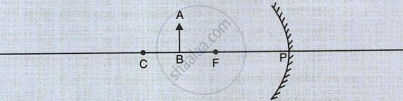
Draw a ray diagram showing how a concave mirror can be used to produce a real, inverted and diminished image of an object.
A concave mirror has a focal length of 25 cm. At which of the following distance should a person hold his face from this concave mirror so that it may act as a shaving mirror?
(a) 45 cm
(b) 20 cm
(c) 25 cm
(d) 30 cm
Give reason for your choice.
How far should an object be placed from the pole of a converging mirror of focal length 20cm to form a real image of the size exactly `1/4`th the size of the object?
Draw a ray diagram to show the formation of image of an object placed at the centre of curvature of a concave mirror. State the position, size and nature of the image.
Name the mirror(s) that can give (i) an erect and enlarged image, (ii) same sized, inverted image
Which of the following ray diagrams is correct for the ray of light incident on a concave mirror as shown in figure?
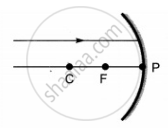
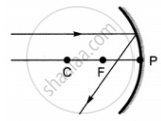 |
 |
 |
 |
| A | B | C | D |
