Advertisements
Advertisements
प्रश्न
Which type of mirror is used by a dentist?
विकल्प
Plane
Convex
Concave
Both Convex and Concave
Advertisements
उत्तर
Concave
APPEARS IN
संबंधित प्रश्न
An object of height 5 cm is placed perpendicular to the principal axis of a concave lens of focal length 10 cm. If the distance of the object from the optical centre of the lens is 20 cm, determine the position, nature and size of the image formed using the lens formula.
Consider the following diagram in which M is a mirror and P is an object and Q is its magnified image formed by the mirror.
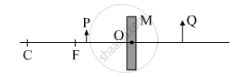
State the type of the mirror M and one characteristic property of the image Q.
A spherical mirror and a thin spherical lens have each a focal length of -15 cm. The mirror and the lens are likely to be ______.
Out of convex mirror and concave mirror, whose focus is situated behind the mirror?
A concave mirror ______ rays of light whereas a convex mirror ______ rays of light.
What is a spherical mirror?
A communications satellite in orbit sends a parallel beam of signals down to earth. If these signals obey the same laws of reflection as light and are to be focussed onto a small receiving aerial, what should be the best shape of the metal 'dish' used to collect them?
Make labelled ray diagrams to illustrate the formation of:
- a real image by a converging mirror.
- a virtual image by a converging mirror.
Mark clearly the pole, focus, centre of curvature and position of object in each case.
The real image formed by a concave mirror is smaller than the object if the object is:
(a) between centre of curvature and focus
(b) at a distance greater than radius of curvature
(c) at a distance equal to radius of curvature
(d) at a distance equal to focal length
Which of the following are concave mirrors and which convex mirrors?
If the radius of curvature of a concave mirror is 20 cm, its focal length is:
A student obtained a sharp image of the grills of a window on a screen using a concave mirror. His teacher remarked that for getting better results a well lit distant object (preferably the sun) should be focussed on the screen. What should be done for this purpose?
(A) Move the screen slightly away from the mirror
(B) Move the mirror slightly towards the screen
(C) Move the screen and the mirror away from the object
(D) Move the screen and the mirror towards the object
A student has to trace the path of a ray of light passing through a rectangular glass slab for four different values of angle of incidence.
(a) Write two important precautions for this experiment.
(b) List two conclusions the student will draw based on his experiment.
A _____________ mirror is used by a dentist.
In which equipment/s do you find ___________________
Match the following.
| Convex mirror | Radio telescopes |
| Parobolic mirror | Rear – view mirror |
| Snell’s law | Kaleidoscope |
| Dispersion of light | sin i/sin r =μ |
| Refractive index | Rainbow |
Beams of light are incident through the holes A and B and emerge out of box through the holes C and D respectively as shown in the figure. Which of the following could be inside the box?

The image formed by concave mirror is real, inverted and of the same size as that of the object. The position of object should be ______.
Identify the device used as a spherical mirror or lens in following case, when the image formed is virtual and erect in case.
Object is placed between device and its focus, image formed is enlarged and behind it.
______ mirrors magnify the object placed close to them.
