Advertisements
Advertisements
प्रश्न
A _____________ mirror is used by a dentist.
विकल्प
concave
convex
plane
none of the above.
Advertisements
उत्तर
A concave mirror is used by a dentist.
APPEARS IN
संबंधित प्रश्न
"A concave mirror of focal length 15 cm can form a magnified, erect as well as inverted image of an object placed in front of it." Justify this statement stating the position of the object with respect to the pole of the mirror in both the cases for obtaining the images.
Study the following diagram and select the correct statement about the device 'X' :
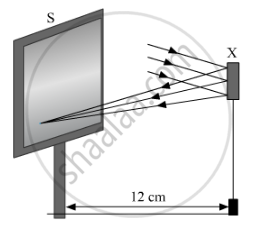
(A) Device 'X' is a concave mirror of radius of curvature 12 cm
(B) Device 'X' is a concave mirror of focal length 6 cm
(C) Device 'X' is a concave mirror of focal length 12 cm
(D) Device 'X' is a convex of mirror of focal length 12 cm
A spherical mirror and a thin spherical lens have each a focal length of -15 cm. The mirror and the lens are likely to be ______.
An object of size 7.0 cm is placed at 27 cm in front of a concave mirror of focal length 18 cm. At what distance from the mirror should a screen be placed, so that a sharp focused image can be obtained? Find the size and the nature of the image.
With the help of a ray diagram, determine the position, nature and size of the image formed of an object placed at the centre of curvature of a concave mirror.
According to New Cartesian Sign Convention:
(a) focal length of concave mirror is positive and that of convex mirror is negative
(b) focal length of both concave and convex mirrors is positive
(c) focal length of both concave and convex mirrors is negative
(d) focal length of concave mirror is negative and that of convex mirror is positive
A bright object 50 mm high stands on the axis of a concave mirror of focal length 100 mm and at a distance of 300 mm from the concave mirror. How big will the image be?
A real image of an object is to be obtained. The mirror required for this purpose is:
(a) convex
(b) concave
(c) plane
(d) either convex or concave
An object is placed 15 cm from (a) a converging mirror, and (b) a diverging mirror, of radius of curvature 20 cm. Calculate the image position and magnification in each case.
Why does a beam of light when it enters glass at an angle? Why does it not bend if it inters the glass at right angles?
How can a concave mirror be used to obtain a virtual image of an object? Draw a diagram to illustrate your answer.
In the following diagram. MM' is a concave mirror and AB is an object. Draw on your answer-sheet a ray diagram to show the formation of image of this object.
Why does obtaining the image of the sun on paper with the help of a concave mirror burn the paper?
Rays from Sun converge at a point 15 cm in front of a concave mirror. Where should an object be placed so that size of its image is equal to the size of the object?
The mirror having reflection surface curved outward ______.
Under which of the following conditions a concave mirror can form an image larger than the actual object?
You are provided with a convex mirror, a concave mirror, a convex lens and a concave lens. You can get an inverted image from
______ mirrors magnify the object placed close to them.
In torches, searchlights, and headlights of vehicles, the bulb is placed ______ of the concave mirror.
