Advertisements
Advertisements
प्रश्न
Why does obtaining the image of the sun on paper with the help of a concave mirror burn the paper?
Advertisements
उत्तर
The rays from the Sun are parallel. When these rays fall on the concave mirror, they converge to a single point on the focal plane of the mirror. Thus, a lot of heat is produced at that point. Now, if a paper is placed at that point to get the image of the Sun, the paper gets burnt because of the huge amount of heat concentrated at that point.
APPEARS IN
संबंधित प्रश्न
Draw a ray diagram for concave mirror when the object is between centre of curvature and focus.
List four specific characteristics of the images of the objects formed by convex mirrors.
For what position of an object, a real and diminished image is formed by a concave mirror?
With the help of a labelled ray diagram, describe how a converging mirror can be used to give an enlarged upright image of an object.
Explain why, concave mirrors are used as shaving mirrors.
If an object of 10 cm height is placed at a distance of 36 cm from a concave mirror of focal length 12 cm, find the position, nature and height of the image.
When an object is placed at a distance of 15 cm from a concave mirror, its image is formed at 10 cm in front of the mirror. Calculate the focal length of the mirror.
A man holds a spherical shaving mirror of radius of curvature 60 cm, and focal length 30 cm, at a distance of 15 cm, from his nose. Find the position of image, and calculate the magnification.
Name the mirror which can give:
an erect and enlarged image of an object.
With the help of a labelled diagram, explain how a concave lens diverges a beam of parallel light rays. Mark the principal axis, optical centre, principal focus and focal length of the concave lens on the diagram.
How can a concave mirror be used to obtain a virtual image of an object? Draw a diagram to illustrate your answer.
A student has to trace the path of a ray of light passing through a rectangular glass slab for four different values of angle of incidence.
(a) Write two important precautions for this experiment.
(b) List two conclusions the student will draw based on his experiment.
State whether true or false. If false, correct the statement.
When an object is at the centre of curvature of concave mirror the image formed will be virtual and erect.
The radius of curvature of a concave mirror whose focal length is 5cm is ______
According to cartesion sign convention, which mirror and which lens has negative focal length?
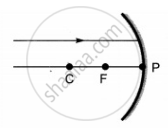
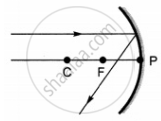
Which of the following ray diagrams is correct for the ray of light incident on a concave mirror as shown in figure?
 |
 |
 |
 |
| A | B | C | D |
An object at a distance of 30 cm from a
concave mirror gets its image at the same point. The focal length of the mirror is ______.
The concave reflecting surface of a torch got rusted. What effect would this have on the beam of light from the torch?
