Advertisements
Advertisements
प्रश्न
If a spherical mirror breaks, what type of mirrors are the individual pieces?
Advertisements
उत्तर
After the breakdown of the spherical mirror, each piece of the mirror is the same type of original mirror (concave/convex), as the reflective background and curvature have no differences in radius.
APPEARS IN
संबंधित प्रश्न
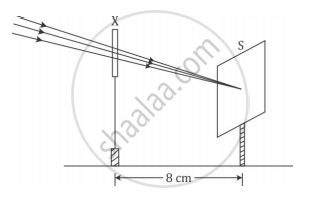
A student used a device (X) to obtain/focus the image of a well illuminated distant building on a screen (S) as shown below in the diagram. Select the correct statement about the device (X).
Define the following term in the context of spherical mirrors:- Principal axis
A ray of light strikes a plane mirror at an angle of 40° to the mirror surface. What will be the angle of reflection?
When a spherical mirror is held towards the sun and its sharp image is formed on a piece of carbon paper for some time, a hole is burnt in the carbon paper.
- What is the nature of spherical mirror?
- Why is a hole burnt in the carbon paper?
- At which point of the spherical mirror the carbon paper is placed?
- What name is given to the distance between spherical mirror and carbon paper?
- What is the advantage of using a carbon paper rather than a white paper?
A coin placed at the bottom of a vessel appears to be raised when water is poured in the vessel.
How is the focal length of a spherical mirror related to its radius
State the kind of mirror used
(a) by a dentist, and
(b) as a street light reflector.
Mention the types of mirrors used as (i) rear view mirrors, (ii) shaving mirrors. List two reasons to justify your answers in each case.
The letters on the front of an ambulance are written laterally inverted like  . Give reason.
Discuss the position and nature of image formed by a concave mirror when an object is moved from infinity towards the pole of mirror.
Name the kind of mirror used to obtain:
A virtual and diminished image
The magnification for a mirror is -3. How are u and v related?
An object of length 4 cm is placed in front of a concave mirror at distance 30 cm. The focal length of mirror is 15 cm.
- Where will the image form?
- What will be the length of image?
An object 5 cm high forms a virtual image of 1.25 cm high, when placed in front of a convex mirror at a distance of 24 cm. Calculate:
- the position of the image
- the focal length of the convex mirror.
Select the correct option:
A concave mirror is made by cutting a portion of a hollow glass sphere of radius 30 cm. The focal length of the concave mirror is:
Select the correct option:
A mirror forms a virtual image (diminished) of an object, whatever be the position of object:
Define the following term:
spherical mirror
If the real image of a candle flame formed by a lens is three times the size of the flame and the distance between lens and image is 80 cm, at what distance should the candle be placed from the lens?
Explain why a ray of light passing through the center of curvature of a concave mirror, gets reflected along with the same pattern.
A converging lens of focal length f is placed at a distance 0.3 m from an object to produce an image on a screen 0.9 m from the lens. With the object and the screen in the same positions, an image of the object could also be produced on the screen by placing a converging lens of focal length.
