Advertisements
Advertisements
प्रश्न
Name the type of mirror used in the following situation:
Side/rear-view mirror of a vehicle
Support your answer with reason.
Advertisements
उत्तर
Convex Mirror: This is because a convex mirror is used as side/rear view mirror because its field of view is larger and it forms virtual, erect and diminished images of objects behind.
APPEARS IN
संबंधित प्रश्न
What type of image is formed:
- in a plane mirror?
- on a cinema screen?
What kind of mirror is required for obtaining a virtual image of the same size as the object?
The shiny outer surface of a hollow sphere of aluminium of radius 50 cm is to be used as a mirror:
- What will be the focal length of this mirror?
- Which type of spherical mirror will it provide?
- State whether this spherical mirror will diverge or converge light rays.
What type of mirror can be used to obtain a real image of an object?
Does the mirror mentioned in part (b) form real image for all locations of the object?
A straight stick partly dipped in water obliquely appears to be bent at the surface of the water.
Answer the following question:
Distinguish between the convex mirror and the concave mirror.
Define the following term:
concave mirror
Define the following term in relation to concave mirror.
Pole
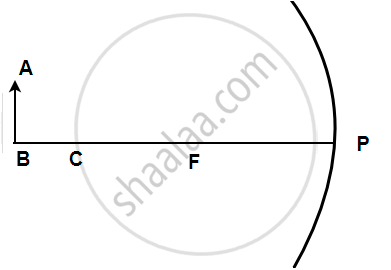
The following figure shows a concave mirror with its pole (P), focus (F), and center of curvature (C). Draw a ray diagram to show the formation of the image of an object AB by the concave mirror.
Define the term Pole.
Define the term Centre of curvature.
Define the term Focus of a concave mirror.
Draw a ray diagram to show that a convex mirror has a wider field of view.
The following Figure shows a concave mirror MM' on which a ray of light incident from a point P gets reflected to meet the principle axis at O.
(a) Find, by construction, the position of the centre of curvature of the concave mirror.
(b) Write down the value for the radius of curvature of the mirror.
(c) Calculate the focal length of the mirror.
(d ) Which relation is used in deducing the focal length from the radius of curvature?
The minimum length of the mirror required to see the full image of the person is half ‘ of his height.
