Advertisements
Advertisements
प्रश्न
In which equipment/s do you find ___________________
Advertisements
उत्तर
(i) Concave mirror is found in torches, headlights, flood lights, solar devices,dentist's mirror.
(ii) Convex lens is used in simple microscope, compound microscope, telescopes, optical instruments and spectacles.
(iii) Reflecting mirrors are used in projector lamps, telescopes.
APPEARS IN
संबंधित प्रश्न
Draw a ray diagram to show the path of the reflected ray corresponding to an incident ray of light parallel to the principal axis of a convex mirror and show the angle of incidence and angle of reflection on it.
Consider the following diagram in which M is a mirror and P is an object and Q is its magnified image formed by the mirror.
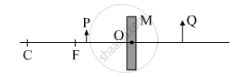
State the type of the mirror M and one characteristic property of the image Q.
Study the following diagram and select the correct statement about the device 'X' :
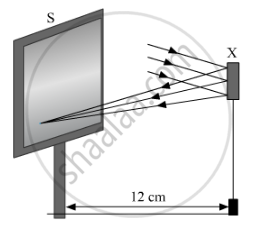
(A) Device 'X' is a concave mirror of radius of curvature 12 cm
(B) Device 'X' is a concave mirror of focal length 6 cm
(C) Device 'X' is a concave mirror of focal length 12 cm
(D) Device 'X' is a convex of mirror of focal length 12 cm
A spherical mirror produces an image of magnification −1 on a screen placed at a distance of 40 cm from the mirror:
(i) Write the type of mirror.
(ii) What is the nature of the image formed?
(iii) How far is the object located from the mirror?
(iv) Draw the ray diagram to show the image formation in this case.
A spherical mirror and a thin spherical lens have each a focal length of -15 cm. The mirror and the lens are likely to be ______.
An object of size 7.0 cm is placed at 27 cm in front of a concave mirror of focal length 18 cm. At what distance from the mirror should a screen be placed, so that a sharp focused image can be obtained? Find the size and the nature of the image.
Three students A, B and C focussed a distant building on a screen with the help of a concave mirror. To determine focal length of the concave mirror they measured the distances as given below:
Student A : From mirror to the screen
Student B : From building to the screen
Student C : From building to the mirror
Who measured the focal length correctly ;
(a) Only A
(b) Only B
(c) A and B
(d) B and C
The angle between an incident ray and the plane mirror is 30°. The total angle between the incident ray and reflected ray will be:
(a) 30°
(b) 60°
(c) 90°
(d) 120°
Out of convex mirror and concave mirror, whose focus is situated behind the mirror?
Copy this figure in your answer book and show the direction of the light ray after reflection:

Explain why, a ray of light passing through the centre of curvature of a concave mirror gets reflected back along the same path.
Briefly describe how you would find the focal length of a concave mirror quickly but approximately
An object is placed at a distance of 10 cm from a concave mirror of focal length 20 cm.
Calculate the image distance.
An object is placed at a distance of 10 cm from a concave mirror of focal length 20 cm.
State two characteristics of the image formed.
An object of 5.0 cm size is placed at a distance of 20.0 cm from a converging mirror of focal length 15.0 cm. At what distance from the mirror should a screen be placed to get the sharp image? Also calculate the size of the image.
A concave mirror produces a real image 1 cm tall of an object 2.5 mm tall placed 5 cm from the mirror. Find the position of the image and the focal length of the mirror.
At what distance from a concave mirror of focal length 10 cm should an object be placed so that:
- its real image is formed 20 cm from the mirror?
- its virtual image is formed 20 cm from the mirror?
A real image of an object is to be obtained. The mirror required for this purpose is:
(a) convex
(b) concave
(c) plane
(d) either convex or concave
Name the mirror(s) that can give (i) an erect and enlarged image, (ii) same sized, inverted image
What is a concave and convex mirror?
